
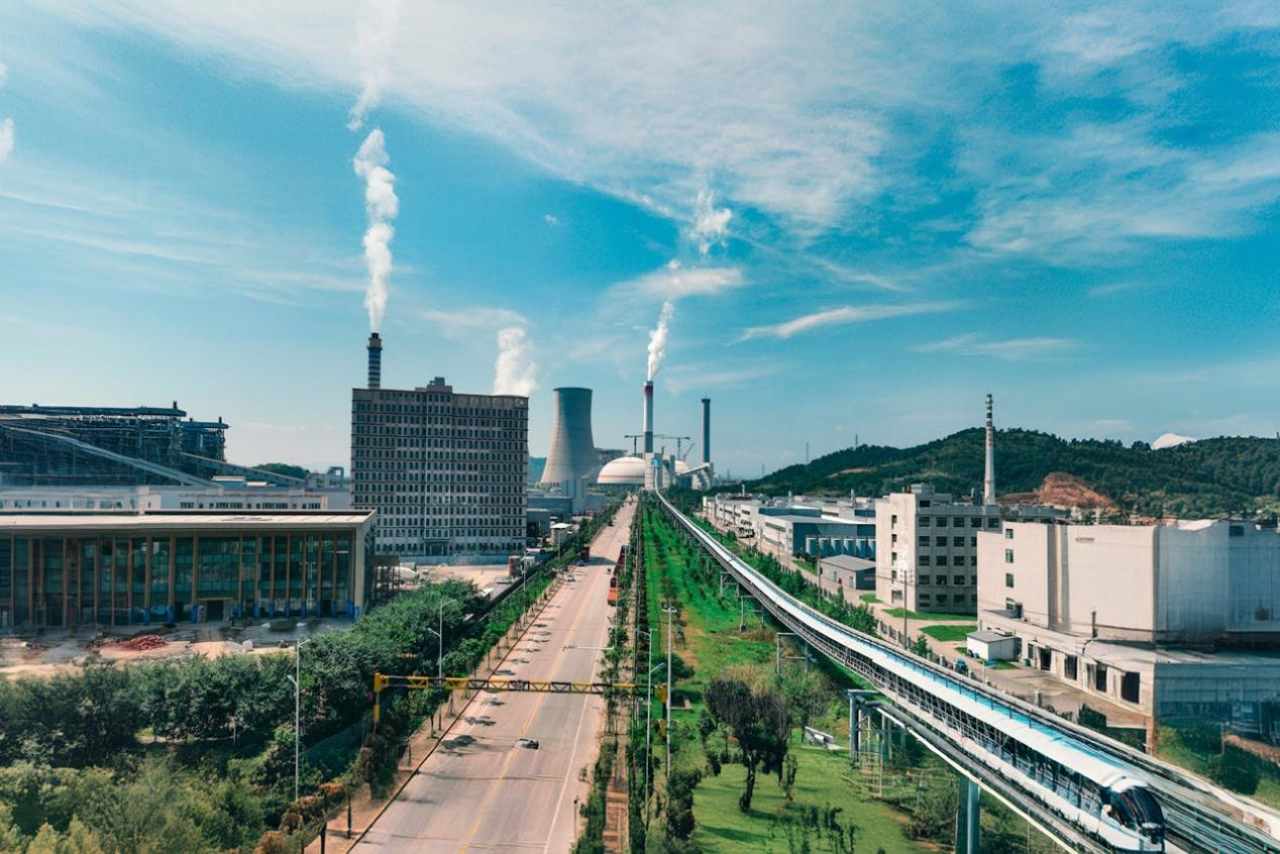
1. Introduction
The new standard of technology in production industries is now based on AI computing, fully automated manufacturing lines, collaborative robots (cobots), and corresponding efficient Overall Equipment Effectiveness (OEE). All this has revolutionized the business landscape of today but has also attracted attention to sustainability metrics.
Because of this, manufacturing businesses of today are now not only interested in throughput and uptime but also pay attention to a separate KPI of carbon intensity per unit in their operations. Factors like strict compliance with regulations, Environmental, Social, and Governance (ESG) reporting, and customer‑driven net‑zero commitments are no longer future considerations but an utmost priority.
We have explored below what’s going on in the decarbonization efforts and how today’s technology in production industry of different product categories is helping businesses around the world to reduce their carbon footprint and the challenges associated with it.
2. Decarbonization Tech in 2026
2.1 AI‑driven Energy & Carbon Optimization
New advanced AI computing systems autonomously work in real time across production lines to optimize their energy consumption and can use the data to predict future demand of these systems with accuracy reaching more than 95 percent.
These AI systems use Industrial Internet of Things (IIoT) data feeds coming from an array of sensors on every machine in a production line, which enables the conveyor speeds and related parts to adjust their speeds and corresponding output according to the predicted demand. Such smart AI-controlled systems are slashing idle-time emissions by 25%.
In production facilities where overheating furnaces are a serious problem, AI-powered neural networks are used to forecast such carbon hotspots. These systems also effectively reroute power to renewables, which directly boosts OEE.
2.2 Carbon Capture, Utilization and Storage (CCUS) & Green‑Hydrogen‑Ready Lines
Carbon capture, utilization, and storage systems use special membranes and modular scrubbers, which are integrated with production lines to trap up to 90 percent of carbon dioxide generated during production. This trapped gas is then used to produce usable items like building materials and synthetic fuels. Such an arrangement essentially closes the carbon loop in a factory production line without halting operations.
“Green” hydrogen is prepped for such production lines, which is produced from greener sources like solar, wind, or electrolysis. Such systems use IIoT-controlled valves and electrolyzer-ready pipes, which work with predictive analytics to effectively blend hydrogen ratios dynamically and result in significantly cutting down Scope 1 emissions by 40 to 60%.
2.3 Decarbonization‑Ready Design & Digital Twins
The latest and greatest digital twin implementation in Industry 5.0 operational standards is a virtual replica of entire factories powered by a real-time feed of IIoT data streams coming from 1000+ sensors per production line. Such a system can simulate production scenarios accurately to significantly minimize traditional operational waste.
With these replica implementations, the twins simulate thousands of scenarios in these production lines to reach effective use of resources and minimize waste materials before the actual physical item is produced.
Engineers and managers efficiently tweak designs pre-build, which results in cutting precious material use by up to 15% and lighter builds for less transport cost (and lower emissions too). A similar strategy is seen in Siemens battery production plants, where prototype iterations were reduced by 50% with such a system, while making emissions low and OEE reaching 95 percent.
2.4 Electrification & Low‑Carbon Heating
Industrial heaters, which usually run on gas, are quickly being replaced with electric arc furnaces and industrial heaters that draw their energy from grid-scale batteries. Such setups are paired with cobot assembly lines to enable low-emission heating with precise operations and are observed to decrease fuel usage by 50 percent in trials.
3. Real-World Examples
3.1 Guided Transitions in Steel & Cement
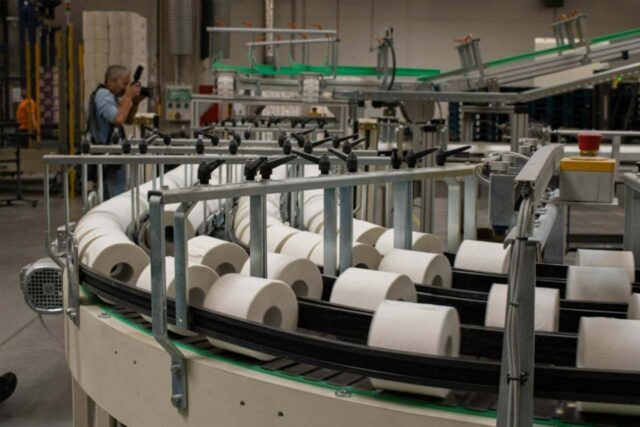
Big names in the steel industry are already experiencing more than a 70 percent cut in their emissions numbers by switching to using green hydrogen and scrap metal. A leading example in the industry is ArcelorMittal, which is using AI-powered electric arc furnaces and similar green initiatives to crunch those numbers.
In the cement industry, HeidelbergCement has already successfully used the digital twins concept for optimizing kiln temperatures via a network of IIoT sensors in its facilities, which is now making its CCUS pilots capture more than 1.5 Mt CO₂ yearly.
3.2 Automated Assembly Lines Slashing Waste
Big names like Tesla are already using their advanced cobot swarms connected with OEE energy monitoring systems that are now reaching over 30% scrap reduction rates and are saving more than 20% energy per vehicle as compared to traditional production lines.
3.3 OEE Dashboards for Energy Monitoring
Advanced OEE dashboards fed with carbon tracking data are being used by Siemens’ MindSphere platform, which enables their factories to monitor data in real time. This system can quickly flag any high-emission bottlenecks in its system, and its high tracking and efficiency are observed to drop energy intensity by 18 percent and boost overall plant OEE to over 90 percent in a single year.
4. Decarbonization Roadmaps for Different Industries
4.1 Automotive, Electronics, & Advanced Manufacturing
Companies in this industry are already aiming for zero-waste recycling loops and 99 percent OEE with the help of already in-place AI-optimized lines. This new industry standard now uses cobots and light-out operations to not only optimize operations but also cut down carbon emissions in big numbers.
For example, battery plants like CATL recorded 15 percent less energy via cobot precision in their production lines and are now aiming for more. This number was paired with a higher efficiency of 1.5 MWh/hour thanks to digital twin implementation, which also helped the company achieve a 40% faster product launch rate.
4.2 Steel, Cement, & Heavy Chemicals
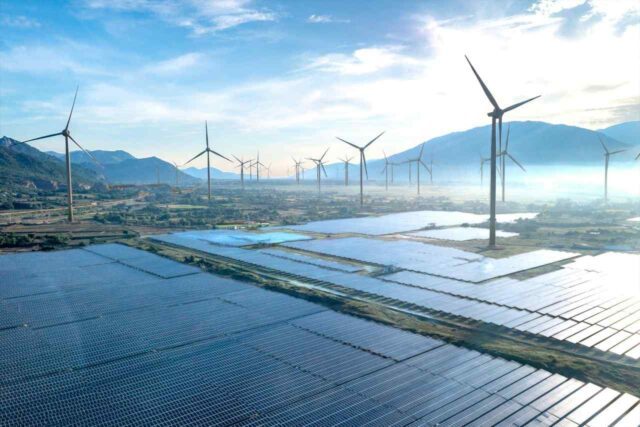
These industries have been the most significant contributors to carbon emissions worldwide, but this is changing as advanced modular reactors now blend captured CO₂ into fuels to form a closed loop (as explained above) and are used for creating other useful products.
Factories in these industries are now using advanced AI-powered OEE dashboards to replace idle time during fuel swaps. For example, BASF Chemicals recorded a staggering number of more than 94 percent OEE with emission drops reduced by 35 percent, thanks to the use of OEE via predictive swaps and H₂-CCUS hybrids in their production lines.
4.3 Food, Pharma, & Light Industry
These are the industries where precision is extremely crucial, and here, automated fillers use AI systems to slash packaging waste, reaching 15% thanks to exact dosing in food plants like those from Nestlé, and Pfizer pilots recorded fewer emissions, reaching as low as 18 percent this year and are expected to lower more in the coming years.
This is happening due to the implementation of advanced technology in production with scalable cobots in their facilities, which work as flexible, low‑carbon work cells that are easily reconfigured for seasonal or product‑change‑driven layouts.
In the pharma industry, a dense network of humidity and temperature sensors is used in cleanrooms and storage vaults, which feed data into their AI dashboards and continuously optimize cooling setpoints.
5. Challenges in Decarbonization Drives
5.1 High Upfront Costs & Uncertain ROI
Green initiatives look great on paper, but the capital expenditure (CapEx) required to make them happen is pretty high in most cases and requires years to see their results in the form of ROI.
To handle this problem, companies are executing their decarbonization initiatives in phased rollouts in which they start by implementing OEE dashboards first, as they are relatively low-cost IIoT expenditures as compared to funding bigger shifts.
5.2 Policy and Regulatory Uncertainty
Although there have been strong green incentives around the world, the policies and regulations towards actual progress remain uncertain, like the U.S. IRA tax credits, which allocated more than $300 billion to this initiative, but eligibility for them keeps evolving.
Although the flux is still there for global green policies, businesses are now hedging via modular tech, ready for green hydrogen subsidies, ensuring operational flexibility amid global policy flux.
5.3 Integration of Legacy Systems
Another common hurdle in the way of modern decarbonization drives is huge empires built with old factories and dated operational systems. Such industries often rely on long-established legacy business models, and integrating modern technology in production for decarbonization is challenging.
In numbers, the latest survey revealed that more than 70% of production plants built pre-2000 lack the basic IIoT port setup, which is already causing 25% integration failures initially. This gap can be overcome with retrofit sensors and edge computing solutions to increase their OEE within months.
6. JETTEST & Decarbonization‑Driven Production
For businesses to achieve decarbonization goals, the entire operation should be integrated with modern OEE monitors deep into their production lines for zero-defect and low-waste automation. Such systems require validation under real-world load and simulated thermal conditions before they make their way to the main lines.
This is where JETTEST, a national high-tech and “Specialized, Refined, Differential, Innovative” enterprise with 18 years of experience in new energy testing, helps businesses worldwide to ensure every new-energy product discussed above is validated before putting it into use. Our portfolio includes fully automated PV inverter test systems, energy storage battery pack test lines, new energy burn-in/aging test systems, and Automated Test Equipment (ATE) systems, all designed to turn decarbonization goals into measurable, actionable results.
For example, our fully automated PV inverter test systems are designed to make solar inverter production more efficient and reliable, which itself helps in lower-carbon grids and fewer failed units in the field. These systems perform inverter efficiency analysis and functional validation. Even a 1-2% improvement in inverter efficiency generates significant additional renewable electricity, replacing fossil fuel consumption. Our exclusive energy-saving load technology achieves 80% energy recovery, further reducing customers’ carbon footprint and testing electricity costs.
All our solutions are designed to enable engineers to achieve measurable OEE and carbon-intensity improvements on the production floor for industries like automotive, grid storage, and solar applications. Our solutions have been widely adopted by leading manufacturers such as Growatt (Vietnam & Thailand), helping them reduce field failure rates by 70% and pass local certifications smoothly.
7. Wrapping up
The modern technology in production is evolving to decarbonization goals to move towards a net-zero future. The new framework involves an array of IIoT sensors, smart cobots, and monitored production lines, all controlled with AI dashboards. For a factory’s green upgrade in 2026, JETTEST’s new energy equipment paves the way for a reliable testing platform, accelerating decarbonization and green energy adoption.