
1. Introduction
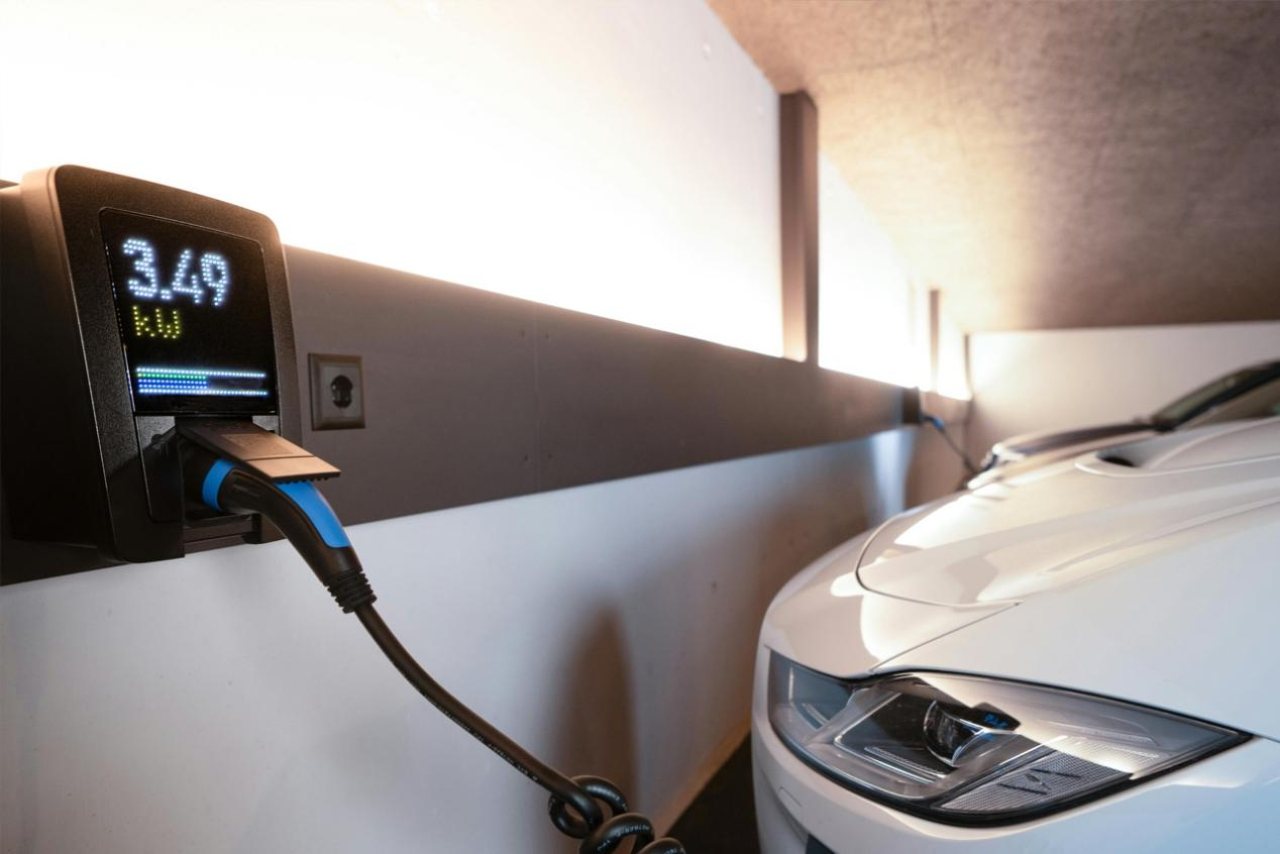
This year, we can all agree on the fact that EVs are now not just a small portion of the modern automotive industry but have quickly moved from niche adoption to mainstream dominance. Surveys (from the International Energy Agency) recorded a more than 40 percent increase in the adoption rate of EVs during 2025. This became possible due to AI now being taken as a standard new technology for manufacturing electric vehicles, empowering faster and more efficient vehicle production.
In 2026, EV manufacturers are pouring billions into R&D of manufacturing EV batteries that can deliver much longer driving mileage & also support faster charging with unyielding reliability. Due to immense competition, such benchmarks should also be met with lower production costs amid geopolitical supply chain strains & volatile raw material prices.
Even with this non-ideal business landscape of 2026, the EV industry has still managed to flourish this year with revolutionary new tech for EV battery production. Below, we have covered recent market trends linked with new technology for manufacturing next-gen EV batteries.
2. EV Battery Market in 2026
It’s astonishing to see that the EV market has already reached more than $150 billion in 2026 with a significant CAGR of 25 percent (McKinsey & Company) and is expected to rise even further. This boom is not all human craving for innovation but was fueled by rising conventional fuel prices and government policies like the U.S. Inflation Reduction Act incentives and the EU’s 2035 combustion engine ban.
All this is driving the development of new technology for manufacturing EV batteries that enable pouch (excel in flexibility), prismatic (for rigid casings enabling tighter packing), and cylindrical formats (prioritize scalability) that prioritize modularity for easy upgrades. In essence, the 2026 EV battery market boom is not just hype but a policy-driven manufacturing boom, which is complemented by positive results coming from R&D on core materials research.
3. Core Materials Advancements
3.1 Silicon anodes
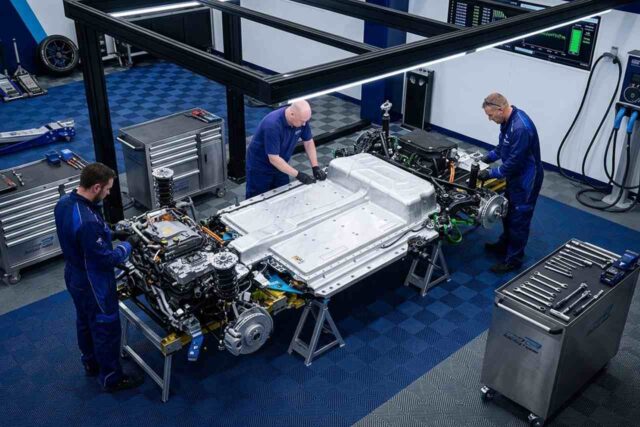
The past standards of EV production were limited to graphite anodes, which used to cap energy storage capacity at 350 Wh/kg. Now, manufacturers of EV batteries prioritize a new selection of materials that amplify charging and discharging performance while streamlining production.
The most successful transition is that of silicon, as it is much better with its 10x lithium storage potential, up to 40% capacity gains over the graphite baseline. Silicon is integrated via dry electrode coating mechanisms, which eliminate solvents to boost yields by 15 percent.
These anodes are then blended at 20 to 30 percent ratios to avoid expansion cracks and can comfortably hit almost 500 Wh/kg, extending ranges to 650 km. All this doesn’t happen in a smooth operation inside the battery, as silicon atoms of these anodes naturally swell 300 percent during lithiation.
To deal with this, silicon nanowires (or porous foams) are used, which can flex without pulverizing during their expansion. Chemical vapor deposition (CVD) reactors are used to deposit silicon nanowires onto copper foils at 500 meters per minute to solve silicon expansion issues.
3.2 Solid-state electrolytes
Solid-state electrolytes like sulfides (LGPS) and oxide garnet types (LLZO) are now taken as the industry standard. Both have their own advantages; LGPS offers 12 mS/cm more conductivity than traditional liquid batteries, and LLZO is superior in air stability. These SSEs can operate in a -30°C to 100°C temperature range and also eliminate dendrite growth.
Advanced techniques of thin-film deposition, like atomic layer deposition (ALD), are used, which can deposit 20-micron layers with ample scaling up to 100,000 cells/day. But challenges related to pressing are there too. Modern factories now handle this via spark plasma sintering, which yields much more flexible sheets to handle enough pressing.
3.3 Recycled cathode
In the modern manufacturing practice of EV batteries, circularity routines of recycled cathodes are important, as they can reclaim more than 92 percent of nickel-manganese-cobalt precursors from end-of-life battery packs. For this, direct recycling is quite common, in which hydrometallurgy is used to restore 99 percent purity of cathodes and dissolve the “black mass.”
Modern factories also embed shredder-free flows in which robotic disassembly units extract modules and then are processed through an AI-powered system to sort their chemistry. And finally, flash Joule heating (a tech that first originated from Rice University) purifies the cathodes in seconds.
4. Automation & Next Gen Production
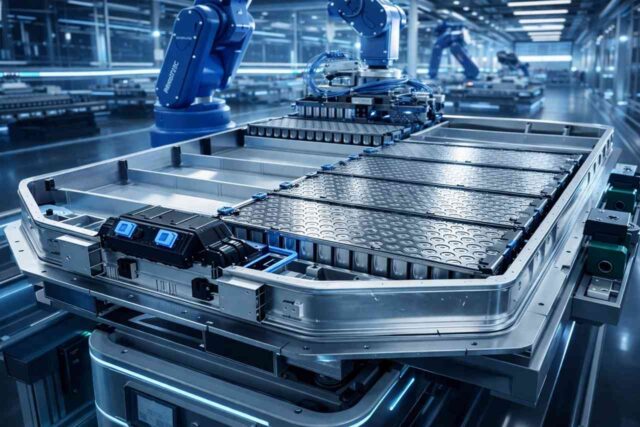
Today’s gigafactories are powered by automated systems, which are the new standard for EV manufacturing. These factories, also termed “lights-out factories,” use an AI system at their core where cobots & neural networks handle 95 percent of tasks. This arrangement delivers extreme efficiency to match the annual 2 TWh demand for battery production, which is up 60 percent from 2025. Such factories are using this AI in these five areas to enhance their workflows.
4.1 AI-Powered Assembly Lines
Manufacturing of next-generation EV batteries uses automated assembly lines covering all the major processes, including electrode coating, stacking, and formation at blistering speeds. These lines can even spot micron defects and can also balance loads, hiking OEE & preventing bottlenecks.
4.2 Precision Welding
Structural integrity in EV batteries is significantly improved with laser or ultrasonic welding of tabs and casings with 0.01 mm accuracy. To minimize heat-affected zones that degrade electrolytes in the battery, automated systems of fiber lasers are used to weld aluminum pouches, which is done much faster than traditional methods using arcs.
4.3 Simulated Workflow
Workflows powered by digital twins are a new normal in the EV industry, as this virtualization slashes physical prototyping by more than 80 percent, as recorded in recent studies. These twins are used to run thousands of scenarios daily and help companies optimize layouts and chemistries of EV batteries.
4.4 3D Printed Components
Advanced printing is frequently used for fabricating current collectors & housings with metal additive manufacturing for EV batteries. Companies use it for speed, efficiency, and lighter parts for batteries, and it also helps slash costs. Latest surveys recorded a drop of $0.50/g from $5 in different facilities.
4.5 Scalable Designs
Automotive companies are increasingly using plug-and-play skids with form-factor flexibility. Such platforms enable seamless transitions between pouch, prismatic, and cylindrical cells within hours rather than weeks. This process is enhanced by AI systems with embedded neural networks that auto-calibrate skid parameters in real time.
5. AI-powered QC for EV Batteries
Recalling reaching more than 1 billion during 2025, companies are raising advanced QC systems to ensure zero-failure cells for the power industry’s unforgiving demands. Below are the five core areas where EV manufacturers are focusing to address battery problems like thermal runaway, capacity drift & field failures.
5.1 High-Voltage Endurance Checks
These stress tests expose batteries to 1,000V peaks, mimicking 800V architectures in premium EVs. During this, Keysight chambers simulate arc faults, ensuring fault interruption within 0.1 ms, and any anomaly during this is flagged by the AI system via voltage fingerprints, correlating to dendrite risks.
5.2 Real-Time Defect Detection
These use hyperspectral imaging techniques that scan electrodes at 1,000 m/min for cracks or contamination. Cognex ViDi algorithms are employed, which classify 99.8% of burrs, triggering air-jet rejects. To spot SEI irregularities, optical coherence tomography is used, which can penetrate 500 μm in the battery, and both help slash costs by 30 percent via fewer battery scraps.
5.3. Vibration Stress Testing
These tests replicate road & seismic rigors at 10 to 2,000 Hz per ISO 16750-3. Some are taking it even further, like electrodynamic shakers from Brüel & Kjær, which are designed to detect tab fractures by logging acceleration to 50 g. Battery data is fed into ML to analyze resonance spectra, predicting 95% of field failure risks.
5.4 Thermal Cycling Rigs
These rigs are used to expose EV batteries from -40°C to 80°C at a rate of 1°C/min, per IEC 62660. After 1,000 cycles, such rapid temperature changes reveal the tiniest cracks invisible to standard inspections, thus making them a valuable QC routine. Moreover, ESPEC chambers leverage liquid nitrogen for precise gradients, while integrated AI-powered IR cameras are used to capture real-time hotspot formation in EV batteries.
5.5 Capacity Fade Analysis
For this analysis, electrochemical impedance spectroscopy (or EIS) is used to track degradation via Nyquist plots with Gamry analyzers running 0.1 to 100 kHz sweeps. This technique models SEI growth, and a predictive ML analyzer uses this data to forecast 20-year fades to 80 percent retention.
6. Future Tech Coming to EV batteries
The coming Industry 5.0 fuses human-AI collaboration and new R&D directions, which are powered by quantum computing. In the coming years, material discovery is expected to rise by 1,000x thanks to such computing power and AI systems. Moreover, sodium-ion batteries are expected to disrupt the market thanks to abundant Na present in nature.
Moreover, self-healing polymers are on their way to EV batteries, which use microcapsule-embedded electrolytes designed to repair battery cracks autonomously, extending battery life by more than 40%.
New battery standards like lithium-sulfur are expected to become the norm, which can output 500 Wh/kg and are going to be tamed by carbon nanotubes trapping polysulfides. Looking ahead, this year marks a pivot to “battery-as-a-service” models for EVs, where people could lease swappable battery packs and would result in optimizing utilization to 90 percent.
7. JETTEST
The future of EV batteries is exciting, with plenty of new R&D promising longer ranges, safer production, and better operating life. This also requires special attention to precision testing in the automotive and power sectors for EV manufacturers. JETTEST is a trusted provider for testing EV power electronics, which ensure the safety and performance of high-density battery cells.
It offers several products to maintain even better safety standards for EVs and their manufacturing. For example, JETTEST’s on-board charger (or OBC) systems are core to EV power electronics, which are designed for multi-channel parallel aging, stress screening, and performance testing for on-board chargers (OBC). These systems are optimized for maintaining battery compatibility in high-power charging and grid-tied applications
8. Wrapping up
All the new technology for manufacturing next-gen EV batteries we are witnessing this year is focused on longer range, safer construction, and durability with less degradation in battery life over the years. Power engineers prioritize scalable automation & advanced testing to safeguard EV battery performance and reliability.