
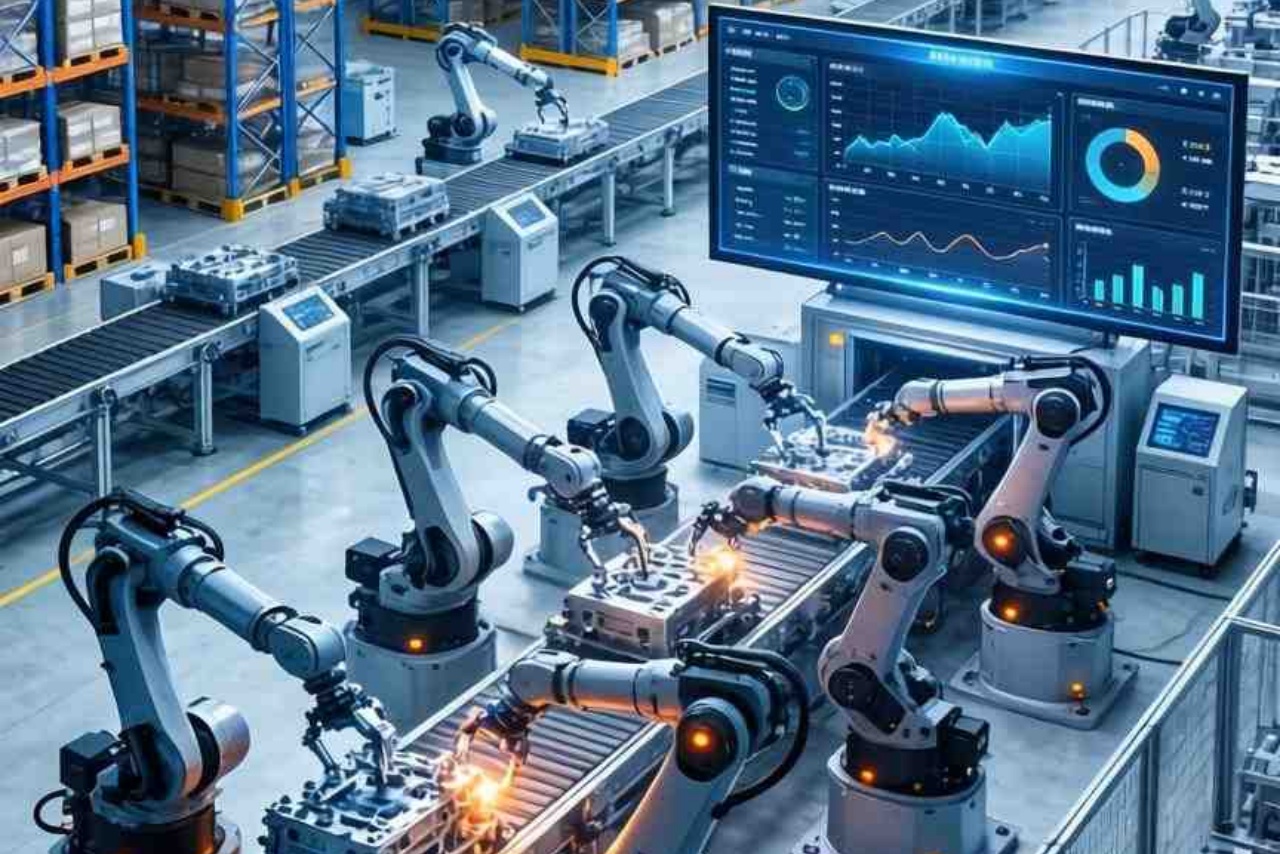
The knowledge about the benefits of automation in the manufacturing industry is important to make organizations realize that robotics, artificial intelligence, and intelligent systems can enhance the efficiency of the whole production and reliability in operations of factories and other industries.
Increased Operational efficiency and Productivity
Automation of manufacturing is one of the greatest advantages that a company can have, as it is possible to significantly boost productivity and still have the same level of output.
Robotic systems and automated machines work 24 hours without exhaustion, giving the factories an opportunity to have more units produced within a shorter duration as opposed to manual production. Semi-automated production lines also reduce waiting time and simplify processes that lead to more production and efficient operations.
Automated systems can perform repetitive activities with accuracy and speed, thus minimising the number of bottlenecks in production lines, and companies can effectively satisfy large-scale production needs.
It has been found that automated manufacturing systems have a high degree of enhancing productivity since machines are more accurate and faster than manual labor in most industrial environments.
Uniform Quality and Accuracy of Products
A stable and high-quality product is another major requirement of modern manufacturing, and the enhanced accuracy and uniformity of products are among the main advantages of automation in manufacturing.
Automated machines execute tasks according to given programmes, and they are very accurate to avoid human error, which usually results in flaws or irregularities during production.
The other benefits of automation technologies are that they facilitate the use of sophisticated quality control based on sensors, cameras, and monitoring systems that highlight defects in the manufacturing process.
Such systems would guarantee that all products are built according to the specification required, and this aspect results in fewer defective products and enhanced customer satisfaction in very competitive markets.
Better Workplace Safety and Risk Elimination
The workplaces in industries may easily have some hazardous activities like heavy machine handling, working in hot circumstances, or accessing materials that may be dangerous.
The enhancement of safety at the workplace is one of the significant advantages of automation in manufacturing, as harmful activities are also sent to the automated system rather than to humans.
Automation helps to decrease the number of accidents and injuries in the workplace and provides safer factory conditions by eliminating direct human contact with risky processes.
Employees will be able to spend time on inspecting the automated systems and carrying out skillful technical work instead of having to do dangerous or repetitive manual work.
Minimized Operational Charges and Wastes of Resources
Another effective benefit of automation in industries is cost efficiency. Organizations that use automation technologies tend to have major operational cost reduction because they achieve labor cost reduction, material waste reduction, and higher production accuracy.
Such monetary gains are notable gains of automation in manufacturing, especially to companies that are looking to achieve maximum profitability levels and still ensure high quality of the products.
Automated production systems also maximize energy use and material consumption through directing the manufacturing processes.
Consequently, manufacturers are able to minimize production wastefulness, work repetitions, and enhance total resource management in their operations.
Smart Factories: Data-Driven Decision Making
The automation is also one of the aspects behind the development of smart factories, where production processes create valuable data that can be used by companies to optimize their operations.
Modern sensors, analytics programs, and monitoring software gather real-time data on machines, allowing the manufacturer to monitor performance, detect inefficiency, and enhance production strategies.
These are the digital data that reinforce the advantages of manufacturing automation since they can predict maintenance, maximize performance, and enhance decision-making.
Consequently, the companies will be able to minimize unforeseen equipment breakdowns and ensure consistency in production timetables as well as achieve long-term operational efficiency.
Sustainable Manufacturing with the help of automation
The issue of sustainability has become prominent in the growth of industry, and the process of automation assists the company in minimizing the environmental impact and, at the same time, staying productive.
Automated systems maximize the use of energy and resources and reduce wastage of materials during production.
These green practices emphasize other advantages of automation in the manufacturing industry since manufacturers are able to achieve their sustainability objectives without necessarily disrupting their industrial process.
The automated monitoring systems are also used to ensure that companies abide by environmental rules and practices that are more environmentally friendly in various industries.
Specialty service providers like Jettest can be of use to organizations that are planning to use advanced testing and automation technologies. Jettest provides automation and testing to professional industries that help them achieve high efficiency in operations, product reliability, and system performance.