
1.Introduction
There is a steep incline in demand figures related to the industries of mobile energy storage power supplies, solar power, and energy-storage components. With the rising demand for such product categories, their manufacturers are heavily spending on implementing automation in quality control, in which aging testing and burn-in systems are listed on top.
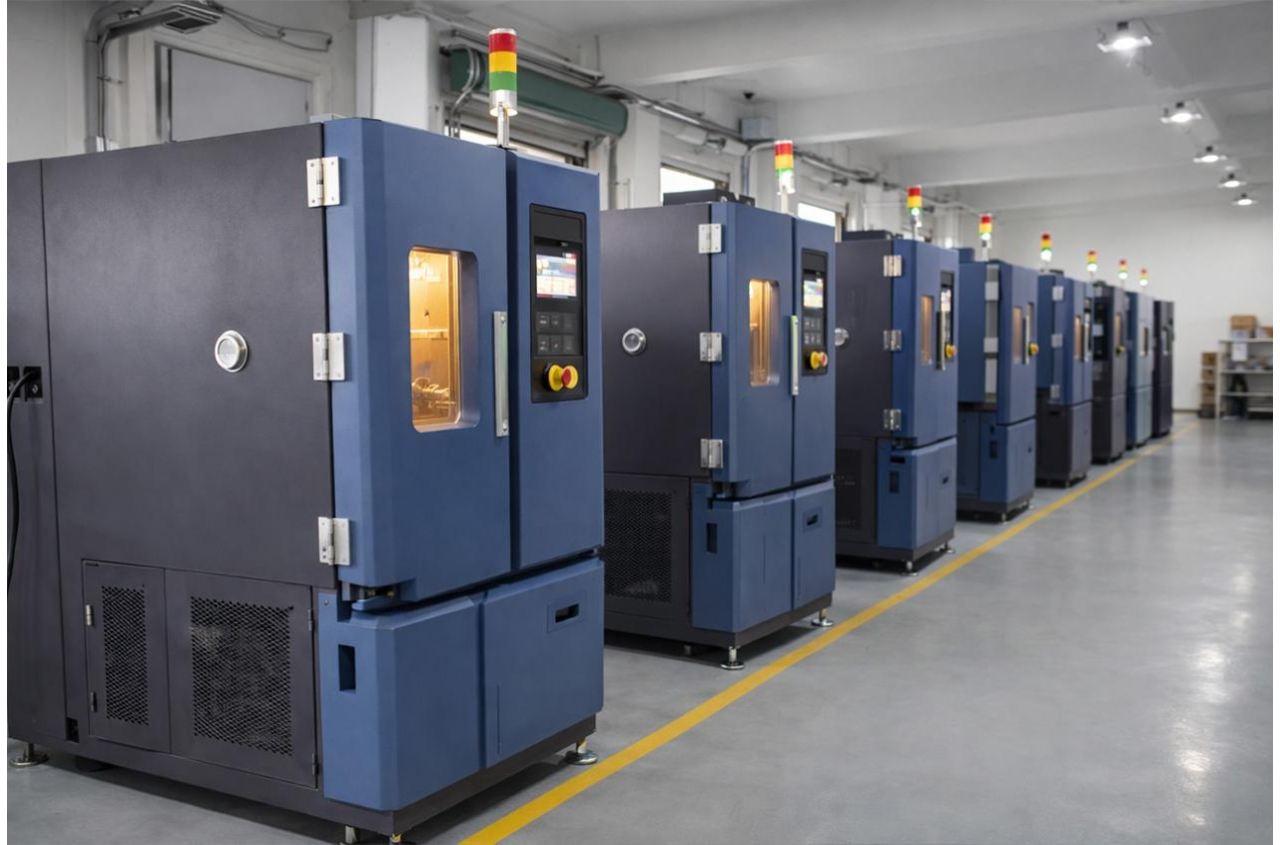
These accelerated QC procedures are implemented in several ways, from thermal cycling to electrical stress, humidity exposure, etc. Regardless of their activity differences, all of them are designed to directly influence final product design and its optimization, which in turn affects the company’s warranty policies and field reliability.
In modern workflows of Industry 4.0, these accelerated testing methods are automated to supercharge both the manufacturing lines and testing routines. And this is already pretty much common, but optimizing them to one’s business needs remains quite challenging in 2026.
Optimizing here means that companies can expect to establish intelligent and adaptive automation in quality control that significantly reduces the cycle time of tests, increases the final throughput & also improves repeatability while maintaining strict compliance.
We have explained below in detail the scope, objectives, and implementation of such optimized automated testing equipment. This guide is relevant to testing labs, OEM test lines, and third‑party industrial aging-service providers working in mainstream industries like solar PV modules, power electronics, and battery cells.
2. Principles of Automating Aging Tests
2.1 Scope of Automation
The automation drive for aging testing routines should first consider an inventory of all the testing tasks and their value when automated. This starts from the activities including DUT labeling/device registration, programming for chamber parameters, data capture/timestamping, periodic calibrations, report generation, etc.
The most common scope in modern automated test routines for aging often includes data capture & sample tracking, as both these activities directly reduce transcription errors and improve final quality control. Next, non-functional scope aspects are also included; common ones are security, uptime, and data retention. Planning for the testing scope will help management decide architecture choices, compliance planning, and procurement decisions.
2.2 Automation Objectives
Scope defines what to include, and objectives here are measurable engineering targets linked with these testing routines. With modern aging equipment, companies usually aim for objectives of cutting test setup time; increasing throughput; improving repeatability while reducing standard deviation of key test outputs; strengthening traceability for regulatory compliance; and lowering cost per test.
These objectives are later measured using KPIs with accepted values for repeatability and variance. For compliance, audit logs, CRC validation, checksums for critical datasets, and time-synced metadata across instruments are heavily maintained. All these objectives to achieve higher success of automation in quality control systems are always compared against operational constraints to get realistic results.
2.3 Levels of Automation
Establishing these levels gives a solid justification for the final maturity model when implementing automation for aging tests. At level 1 of automated drive, the model includes basic digital support, semi-automated logging, instrument drivers, and scripted sequences for the most commonly used test profiles.
Level 2 of automation manages test schedules across different instruments, enforces preset sequence logic, & captures synchronized datasets against DUT. This level handles resource management features that reduce idle time of the testing equipment and also increase throughput. Level 3 connects LIMS or MES enterprise systems of a facility with this testing equipment.
The data link includes standardized reporting & audit trails suitable for related certifications and warranty evidence the company is dealing with. Finally, level 4 is the highest form of automation drive, which establishes closed-loop test adjustments to implement ML-based anomaly detection and also executes predictive maintenance for testing equipment itself, thus implementing modern quality control standards.
3. Optimizing Automation for Aging Tests
3.1 Optimization Goals for Aging Automation
Before you embark on the journey of optimizing your aging test routines, set its goals, which should be specific, measurable, and tied to business outcomes. Common ones are reducing test setup and cycle time, minimizing human error in data capture and sample tracking, increasing throughput without compromising repeatability, lowering cost per test while maintaining quality standards, & improving traceability for regulatory and warranty compliance.
3.2 Streamlining Test Sequence Design
Once you know what you are targeting for your aging tests, the next step is implementing suitable test sequencing, which, if ignored, can easily lead to wasted chamber time, engineering overhead, and inconsistent results. The sequence of electrical, thermal, humidity, & mechanical aging stressors needs to be done with scripted and reusable test profiles with embedded parameter validation and auto-correction.
In modern testing routines implemented for automation in quality control systems, machine learning is used to adapt test parameters during a test of a device under test, which is commonly implemented in battery testing routines. To ensure consistency in aging test results, engineers standardize their test sequence for these tests, which also simplifies training for everyone.
3.3 Intelligent Resource Allocation/Scheduling
Engineers shouldn’t see DUT unattended in chambers or testing equipment remaining idle during testing routines. To avoid that, automated queuing systems with priority rules are implemented, which can also set test schedules according to high-value DUTs and/or tests with tight delivery deadlines.
For such resource management, integration with the facility’s manufacturing execution system is done to carry out this prioritized operation for certain devices. Moreover, such an arrangement enables automated work order creation, completion tracking, cross-departmental visibility, and real-time dashboards showing chamber utilization and test queue status.
3.4 Pre-Test Validation & Automated Calibration
Once operations and scheduling are set, the next step is to optimize test accuracy and repeatability in aging tests, which is commonly done with the help of auto-calibration routines for chambers and sensors. This can automatically verify chamber temperature, sensor accuracy, power supplies, measurement instruments, etc., and auto-calibrate when needed.
3.5 End-to-End Traceability
Manufacturers whose products are very sensitive to warranty claims and related regulatory compliance should be focusing on continuous sample tracking through every test stage. For this, manufacturers use a barcode or RFID tag at the start with detailed DUT attributes and maintain data association by linking all measurements to that one unique DUT ID.
The final automated report generation system should maintain a full traceability chain for each DUT, including exception logs, pre-test validation results, calibration logs, and recovery actions after the tests.
3.6 Leveraging AI/ML for Continuous Improvement
To optimize “scripted execution” to “intelligent adaptation” in the highest level of automation, machine learning models are repeatedly trained on historical test data so that the closed-loop system can work with better sample identification and suffers less from false-trigger automatic test adjustments.
To get better insights so that the aging test profiles can be further refined and can get continuous improvement, it is recommended to aggregate test data across all DUTs. This is done to identify which test profiles used are producing the most predictive failure data & can be used to further reduce aging test duration for profiles that show early saturation.
4. Operational Considerations
Even though modern automated systems for managing aging tests are incredibly versatile and efficient, a holistic approach to implementing them is still needed for optimizing one’s operations. For managers to deliver the promised ROI of their automated drives for testing routines, they need to focus on these four areas because their investments become a costly burden.
4.1 Training for Lab Automation & Data Teams
Starting from the first level of automation to the highest one (discussed above), untrained or undertrained staff can easily lead to human error, delayed responses to faults, & misconfiguration. Even a sophisticated automation investment will fail if training is not proper, and this is not acceptable, especially for product-sensitive industries like power electronics, battery manufacturing, and solar products.
Training should target skill sets of scripting languages, instrument control protocols being used in the facility, & test management software interfaces. For management, training in database management, visualization tools, & statistical analysis is necessary.
4.2 Better Process Documentation
It is usually managed during phase 1 of automation (discussed above) and is often the most commonly mishandled when automating aging tests. Such smart testing equipment and its integration are a big change in a manufacturing setting, and without proper change management, staff operating it can misuse automated features, leading to lower ROI.
To avoid that, develop documented processes in which change management and process documentation include the new workflows of automated testing gear for assigning tests. These should also include related process documentation covering test sequence design, sample tracking, chamber configuration, exception handling & final report generation, and how automated systems affect these steps.
4.3 Better Maintenance routines
The testing hardware itself needs regular maintenance and calibration checks for it to operate with desired results. Management needs to establish a detailed predictive maintenance strategy targeting regular calibration of testing chambers, their sensors, & power supplies.
Such automated maintenance is handled with a test management system that triggers automatic calibration schedules when certain usage thresholds are reached. Moreover, manual inspection of chamber wiring harnesses, door seals, their software compatibility, and other related operational parameters should also be managed along with these automatic calibration routines.
5. Automated Testing Success with Jettest
Manufacturers planning to invest in automated testing routines: JETTEST enables them to achieve their automation goals with its industry-proven portfolio of products like the Testing and Packaging Line for PV Energy Storage Inverters and Mobile Energy Storage Power Supply Burn-in System. Both are designed to automate testing routines with smoother integration while achieving higher throughput, better repeatability in testing results, & full traceability.
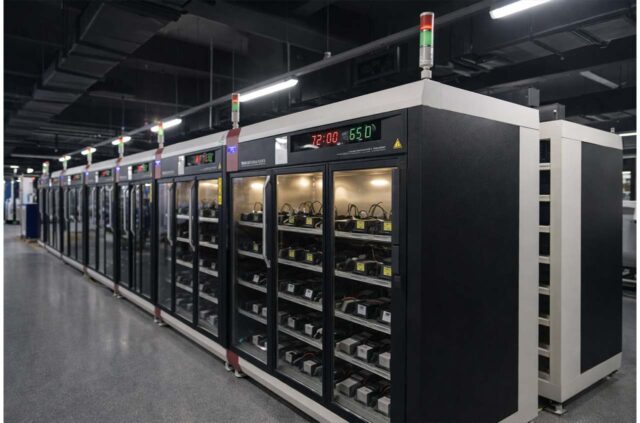
The burn-in system is designed for automated aging validation of portable energy storage units, outdoor power systems, etc., and features real-time monitoring; barcode/RFID integration (suitable for optimizing the discussion above); uninterrupted testing with automatic exception handling; and standard data logging with CRC validation.
Similarly, the testing and packaging line mentioned above implements endurance testers, including standardized electrical & thermal stress, to ensure the final products meet warranty requirements.
Optimization alone is not enough to get automation success in testing routines, but partnering with industry leaders like JETTEST ensures that manufacturers make products that actually meet field reliability expectations before deployment and are made with predictable automated production lines.
6. Wrapping Up
The key to optimizing automation in quality control when implementing aging and burn-in testing routines is in a structured approach to operations. This includes careful objective selection, an optimization framework, documentation, and well-planned staff training. Partnering with a reliable test equipment provider like JETTEST increases the success rate and also ensures a smoother process transformation.