
1.Introduction
The modern industrial landscape of manufacturing electronics has quickly undergone a complete overhaul with the arrival of AI and machine learning on factory floors. In this fast-paced transformation, the future of automation in manufacturing power supplies for modern technologies is also embracing a big change towards better manufacturing efficiency and higher standards of quality control.
For such a high-stakes industry that powers almost everything on the planet, understanding these AI-powered manufacturing shifts is not optional for maintaining market competitiveness and keeping up with the growing demands of energy-efficient power supplies. Below, we have compiled what’s going on in this market segment and how power companies involved in producing power supplies are embracing the latest AI wave.
2. Automation in Manufacturing Power Supply Systems
Almost the entire production cycle of power supply systems is now touched by new advanced automated systems and is increasing efficiency and accuracy. From PCB beds to final testing procedures, everything is being driven by greater efficiency & accuracy.
At each level, factories have significantly minimized human variability and manual interventions in core industrial activities like solder application, torque settings, component placement on PCB, and inspection thoroughness.
This is a much-appreciated & highly profitable upgrade to manufacturing resources in power supplies, as such products are very expensive when it comes to claimed warranties, recalls, and related issues in the field but have a much lower price tag when sold.
Take an example of a small power supply unit in a smartphone charger; it’s cheap in practice, but if the PSU unit is faulty, that can cause recalls of millions of units and probably a major blow to the company in terms of revenue. This is where automated manufacturing is making things profitable and safer for power supply companies in the past few years.
3. Key Tech Driving Automation for Power Supplies
3.1 Surface-Mount Technology Automation
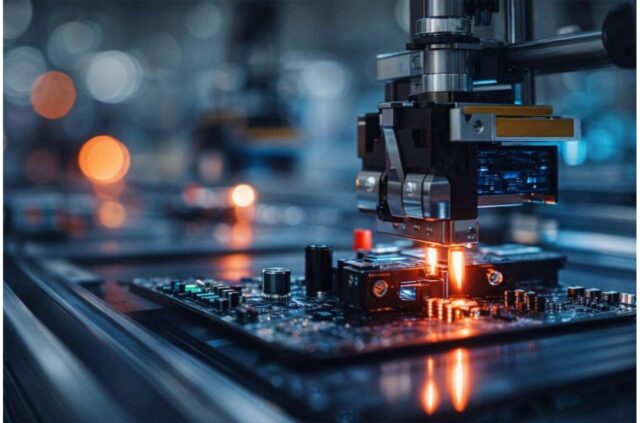
Automation here delivers high assembly density, miniaturization, higher reliability, and lower material costs. This is how it works: SMT technology uses no holes to mount electronic components onto the surface of a PCB pad, which works with a laser-cut stainless steel stencil and squeegees. These two spread solder paste across the stencil at controlled pressure & deposit precise paste volumes as low as 0.3 mm³.
Next, advanced 3D solder paste inspection systems check these pastes and flag any point that has abnormal measurements in terms of volume, area, height, & alignment. Next come the high-speed SMT placement machines, which quickly install power supply components on the PCB with extreme precision before the solder paste dries out.
This is where these automated systems really outmatch human manufacturing routines, as SMT placement machines running with AI-powered control systems can easily install 100,000 components per hour on power supplies, and all that with a placement accuracy range of ±25 micrometers.
An additional layer of QC done by automated optical inspection verifies the placement of the solder and attached components on PSUs by taking pictures and processing them through machine vision algorithms.
This background ML quickly compares images against reference standards stored in the datasets and flags any defects, all happening in an instant. These technologies are now reported to deliver more than 94 percent FPY with 60 to 90 percent smaller component sizes.
3.2 SCARA Robots & Cobots
Both complement each other in manufacturing industrial and commercial electronics power supplies, where they are both used for high-speed component placement in PSUs, screw locking, selective soldering, rail clip automatic feeding, etc.
Both differ in terms of speed and safety; cobots are designed to be deployed alongside humans and stay within the human physical safety barriers. These cobots are built with presence-sensing sensors & force-limiting technology that make them safe to use in PSU manufacturing steps requiring precision.
Meanwhile, SCARA robots are lightning fast and move rapidly for handling quick installation of PSU components and other similar activities. Because of their faster movements, they are not fit for working alongside humans and require physical safety guarding, including cages and light curtains in some cases.
Latest numbers from IDTechEx suggest that defect rates in electronics are down by 30 percent vs. human inspection, and more than 55 percent of cobot market share is coming from the electronics industry due to their use in manufacturing PSUs and other similar product segments. These numbers suggest that the future of automation in manufacturing power electronics is promising, as the industry at large will make huge operational savings from these new technologies.
3.3 AI & ML-backed Quality Control
Again, advanced computer vision systems powered with deep learning algorithms are used for a separate quality control layer of power supplied being produced at scale. These automated layers are built with convolutional neural networks connecting industrial cameras and 3D scanning modules to thousands of labeled examples of both defect types and acceptable products, all fed into ML models.
This network learns the patterns of both defects and the perfect ones in parameters like tombstoning, solder bridges, surface scratches, component misalignment, etc. This knowledge enables it to verify final component placement and soldering with exact specifications and with real-time decision-making capability.
Latest research across different studies of power supply manufacturing sites indicates that AI QC’s transformative impact is huge, as such systems lowered costs in quality control operations by 31 percent & also resulted in more than a 47 percent reduction in warranty claims in mass-scale produced power supplies. All this is achieved with a detection accuracy of 99.8 percent for surface defects as small as 0.1 mm.
3.4 IIoT & Digital Power Management
The power supply manufacturing industry needs power management for itself too, which is now managed with the help of the “Industrial Internet of Things.” These on-site sensors work with cloud or edge computing platforms, and their data is converted into universal language to talk with the rest of the industrial entities by using protocols like OPC-UA, EtherNet/IP, MQTT, and Modbus.
Massive datasets coming from smart power supplies in factories are analyzed by machine learning algorithms to forecast equipment failures. or replacements. Apart from triggering operational failure warnings, these sensors help reduce power consumption in the factory and also significantly reduce maintenance costs.
In recent studies, IIoT deployment was found to reduce 24 percent during power supply production and its final testing routines, with unplanned downtime going as low as 50 percent. This self-optimizing manufacturing ecosystem of IIoT helps manage power in business operations and helps reduce operational costs as well.
4. Future Trends in Power Supply Manufacturing
4.1 Self-Optimizing Systems
Future factories won’t need commands to fix issues but can use advanced ML and computing of automated systems to fix PSU production errors in real time. For this, these factories use closed-loop solder control, which makes the reflow ovens adjust thermal zones by analyzing real-time board density data to get rid of incomplete joint melts and warping.
Component placement tuning is done to adjust even the slightest manufacturing variances in incoming microchips, and advanced acoustic wave testing is implemented, which uses special high frequencies to tune the winding tension on the assembly line in case of a defect.
However, such smart factories require substantial initial capital investment for self-optimizing systems & significant time to mature the operations. But 24/7 production without shifts, higher scalability, reduced costs, & fewer errors make them attractive, pushing many large organizations to already invest in this direction.
4.2 Digital Twins in Production
These digital twins are used for how power electronics are designed, validated, and manufactured. One of the most common uses of digital twins in this industry is during stress simulation, where engineers use pixel-perfect replicas of their factory’s production line quality standards to predict exactly how their power supply unit will degrade in the future.
For this, the digital replicas of products consider factors like extreme heat, voltage spikes, vibration, etc., for a typical timespan of 10 years. Techniques like extreme thermal cycling, mechanical and vibrational fatigue, and electrical transient stressors are used for this purpose. Such a system is used by manufacturers to make thermal profile adjustments during SMT reflow, which results in preventing component defects and better first-pass yield numbers.
Moreover, predictive maintenance is heavily employed, which uses sensor signals from physical vacuum-impregnation tanks to check whether pump seals will fail and, if so, when that approximate time will be for the mean time between failures. These twins are also linked with factory floor machinery where unscheduled operational downtime is minimized.
These digital replicas represent the future of the power supply manufacturing industry, and the ones who have already adopted these technologies are observing substantial results. For example, GE Digital Twin Savings are reported to be more than $1.5 billion in terms of saving downtime, maintenance, and detecting faulty items.
4.3 Sustainable Manufacturing Practices
From raw material sourcing through product end-of-life, almost every step in manufacturing industrial power supplies of each scale is moving towards sustainable options. Companies are heavily investing in circular economy principles and aiming to achieve energy efficiency while reducing waste in their manufacturing routines for power supplies.
For example, lead-free solder recapturing is done with the help of automated wave soldering machines, which can efficiently isolate & recycle dross. This mechanism drastically reduces both raw material costs and heavy metal waste. Similarly, automated dispensing systems implement eco-friendly potting to seal components on power supplies, which is done with bio-based resins in precisely measured quantities.
Moreover, advanced testing beds to carry out regenerative burn-in testing are being used to suck the energy expelled during the high-load testing routines and are fed back into the main power grid of the facility to reduce power drain. Overall, these systems work together in harmony to reduce environmental footprint while producing error-free power electronics.
4.4 Fully Autonomous Manufacturing Plants
In medium and large-scale power electronics industries, lights-out manufacturing is making its way with autonomous mobile robots for transportation, advanced visual inspection for QC, and automated product customization done in “dark” factories on its own.
These plants are now run with a centralized AI control where all processes, starting from material handling to final quality control and packaging/stacking, are done with AMRs and automated SMT lines, selective soldering robots, and AI-powered vision systems.
Early adopters are observing huge benefits like 24/7 production of power supplies without breaks or holidays, significantly lower labor costs, utility cost savings in many areas like lighting and other areas where humans are directly involved in work, and minimal waste with consistent quality standards.
5. Jettest for Autonomous Manufacturing Success
When transitioning to the above-mentioned autonomous manufacturing technologies, power supply manufacturers’ biggest challenge is to overcome compatibility issues, maturing time, and modern standards of QC management. JETTEST enables such companies with its next-generation fully automated burn-in lines & multi-zone aging equipment to achieve the above-mentioned autonomous success even in a high-stakes environment.
In their portfolio, products like the fully automatic test and burn-in line are used by transitioning companies to Industry 4.0 automation standards. These integrated lines combine testing, burn-in, and aging in one integrated system. They execute PCBA automatic testing, during which they verify different quality aspects of supply circuit boards, including component soldering quality, position of components, and functional performance parameters.
These lines are designed to support high throughput of the above-mentioned smart factories, reaching 100,000+ PSU components per hour, with SMT line speeds. Such systems connect their test data directly to the industrial cloud for predictive maintenance & to maintain an improvement loop in manufacturing power supplies.
To fully embrace and unlock automation wonders in power supply manufacturing, JETTEST’s comprehensive production solutions are highly recommended to gain full-process testing coverage and operate high-stakes manufacturing businesses like power supplies with higher success.
6. Wrapping Up
The future of automation in manufacturing industry, linked with power supplies and power electronics as a whole, is undergoing a huge transformation from operational to management level. These technological shifts require sizable initial investments, but the outcomes are significant. Integrated testing lines from JETTEST combine an integrated quality assurance layer in such a high-stakes manufacturing environment.