

1. Introduction
Automation ranges from a full-stack AI-driven manufacturing environment with fully autonomous robots and cobots working alongside humans. It can also be as simple as a robot doing simple pick‑and‑place things in a production site. No matter which scale your business requires, the question of “What is automation?” has quickly changed to “What is the ROI of automation?” for my business.
In a typical manufacturing facility, the ROI can be generally observed after 12 to 36 months, but how to calculate and forecast this payback is another significant question here. Here, we are going to look into methods of calculating the expected revenues from automation in manufacturing plants, along with practical ways to maximize results in an increasingly competitive environment in 2026.
2. ROI of Automation in theory
Here, plant engineers and stakeholders in this facility are interested in comparing the total financial returns and savings of an automated system in their manufacturing business (it can be other industries too) against the total cost they had to allocate when implementing and operating it.
The cost savings contributing to better ROI can range from reduced scrap during production, lower energy use, greener operations, fewer breakdowns, and much less expenditure of labor. The benefits in ROI are classified as hard outcomes (higher revenues, lower tangible costs) or soft outcomes (higher customer satisfaction, improved safety, etc.). Both need to be quantified by managers before they actually apply a new automated system to their production facilities.
3. Why Calculate ROI of Automation?
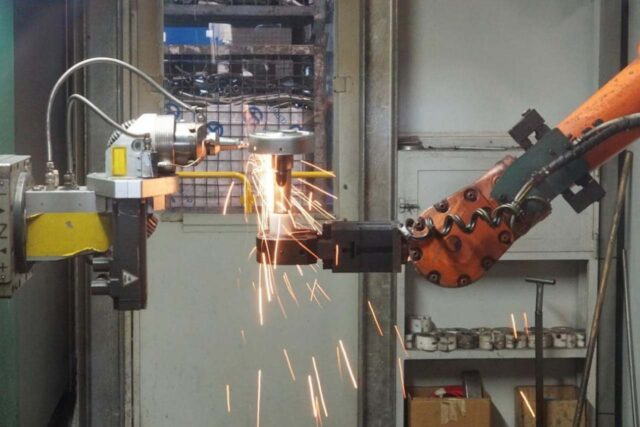
The most obvious reason is to justify a capital release and not just a small bill; planners and high-level stakeholders in a firm have to see a potential payback from an investment of hundreds of thousands of dollars, sometimes per line, in their manufacturing facility. And for that to happen, they need clear numbers to work with and to assess investment feasibility.
Large-scale enterprises have multiple automation opportunities across their businesses, and they must prioritize a few first based on ROI and long-term market conditions. Calculating such values helps them compare these options and pick the ones that offer the most significant and quicker financial benefits.
4. ROI Calculation Methods
4.1 Traditional Formulae
This is the most common formula that managers use to show stakeholders the direct benefits their firm will receive for every dollar spent. This is an estimation of the results and shows a big picture to the parties involved. This can also be modified for annual returns with this formula:
4.2 Efficiency of ROI
Sometimes, managers of large-scale enterprises are also interested in noting the man-hours recovered rather than the immediate financial benefits of an automation system in a manufacturing facility. In this case,
Value of Time Saved = Total Hours Saved × Average Hourly Wage
Management uses this to free up their staff for high-value work and automation in their manufacturing operations to significantly reduce the time spent on repetitive tasks like regression testing.
4.3 Net Present Value
When management plans for much larger or more strategic automation initiatives, it uses the concept of NPV. This number shows the company’s cost of automation in terms of its capital or risk tolerance by discounting future cash flows to today’s value of that investment. The formula to calculate that is:
In this formula, n is the project timeline, and net cash flow is the net benefit received by that year. In simple words, managers use this number to see if a future profit after such automation is actually worth it today, after considering the time and risk involved for this investment. A positive number from this indicates a financially attractive investment and vice versa.
Since the profits to be made in the future are less valuable than money today, the managers ask a question: If we spend money on this automated initiative and expensive project today, will it make us more money in the future after considering risk and time?
4.4 Total Cost of Ownership
Managers and their accounting teams usually consider the entire lifecycle of the investment for their automation plans to get the real and most accurate cost of such an upgrade to their manufacturing facility. This means that the planners look into factors like implementation + training + maintenance + potential downtime.
4.5 Internal Rate of Return
The IRR goes one step ahead of the NPV by asking at what value of returns the project is actually worth carrying out, even if it is showing a positive NPV. IRR is the value at which the returns and costs become zero. From there, managers and engineers adjust the risk and time attached to a project.
Here, another term called “hurdle rate” is significant, which is the minimum return the company requires in its aim. For example, a company’s automation upgrade project with an 18 percent IRR and a hurdle rate of 10 percent means that the project will earn an 18 percent return per year, and 10 percent is the minimum for the company to make it worth doing.
5. Maximizing ROI in 2026

Okay, now you are all set, as all the numbers are on the table, and you are aiming for the next move. But silent and overseen strategic moves can prove to be a disaster for such initiatives and, in some cases, even backfire for businesses.
To get max results for your next automated drive, thorough selection, process design, and organizational change are needed. Consider these words of wisdom extracted from the experience of firms successfully running automation in their manufacturing facilities.
5.1 Right‑sizing the automation scope
Over‑automating is the most common strategic mistake made by businesses all over the world in 2025 and is the most common reason for disappointing ROI. Identify highly variable lines, which can often lead to long lead times, and focus on automating high-volume and repetitive tasks first, rather than the prime work of the manufacturing process.
Moreover, one should focus on the manufacturing line with intensified labor or processes with clear bottlenecks, which can be avoided with automation. The strategy should be to start narrow with a well-defined scope that is effective for the end goals.
5.2 Factor in Soft benefits and Indirect gains
Underweight soft benefits like better quality and higher customer satisfaction, along with safer manufacturing operations, are also common in automation plans. Companies now take these soft goals as their rough monetary equivalents and actual annual benefits.
For example, the cost of an incident that is avoided or the revenue uplift from on-time delivery. These soft benefits, when included in the ROI plan, also make the investment more attractive and force managers and engineers to define how they will measure success beyond just the usual goal of labor reduction.
5.3 Go for Modular & Re–configurable systems
As technology is evolving on an exponential scale, investing in automation systems that are modular and can be reconfigured has become extremely crucial for higher ROI in a long-term plan for a firm. Prioritize systems with modular robotic cells that have swappable grippers and end-effectors with a different scope of products.
Seriously, look for sorting systems and conveyors that can be re-routed and extended for a future redesign. Moreover, such automated systems should be running software that can support multiple product categories and inspection criteria.
5.4 Risk Management
An automation initiative can easily fail if the wrong process is chosen for manufacturing plants. Another common mistake is to select the wrong technology or operators who are not properly trained, which can even backfire on growth ambitions.
In standard practice, a rigorous ROI exercise forces managers and plant engineers to surface their assumptions and properly quantify them. If those assumptions are too fragile, the ROI model being used will itself reveal that early, giving you enough time to adjust the scope being set, the technology used, or the expected outcomes before committing to such an automation upgrade.
6. Increase ROI with JETTEST
The entire planning and all the calculations mentioned above for a successful automation drive depend on how well manufacturing systems are tested, validated, and even maintained well before the advanced deployment. This is a well-established industrial fact and should NOT be ignored by the management to get guaranteed results in their automation initiatives.
For a successful automation upgrade, companies can partner with JETTEST, a leading industrial platform for streamlining the testing and validation of automated systems. Already engaged with world-leading manufacturing businesses from all around the world, the company specializes in industrial automation testing, migration to automated systems, final validation, and continuous improvement.
For this, its inspection equipment, like the optical shaft inspection equipment from JETTEST, is a high-end precision tool designed for conducting high-volume, high-accuracy shaft inspection employed in automotive, powertrain, or mechanical assembly production. This device can accurately spot surface defects, warpage, or machining errors while generating log pass/fail data and statistics for quality control and traceability.
Such products play a pivotal role in a company’s automation ambitions and increase ROI numbers as they directly help manufacturers effectively reduce production scrap and automate inspection in their facility, where once manual checks were used. Combine this with the platform’s electronic loads & programmable DC power supply products, all enabling a reliable and accurate feed into your ROI models, resulting in lower defect cost, higher yield, and improved uptime.
7. Wrapping up
In the past, the ROI of automation used to be a side topic for organizations, but now it’s not a choice but a need. By considering the above-mentioned cautionary methods, strategies to increase ROI, and partnership with JETTEST, you can mark a truly profitable ROI‑driven operation for a very long time.