
1. Introduction
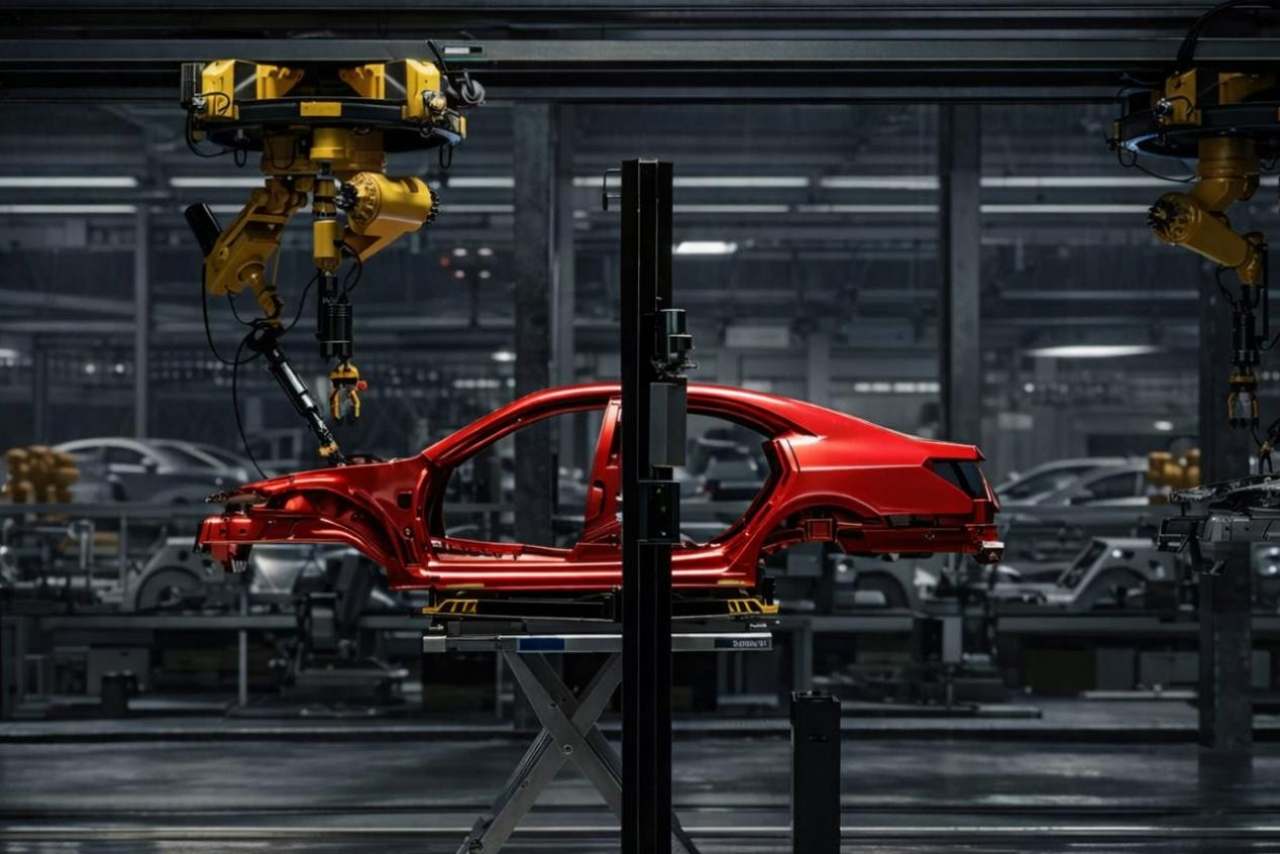
Every bolt tightened in a humming automotive assembly line saves dollars, and every predictive algorithm working behind them averts a shutdown. In today’s automotive industry, sustainability isn’t just a buzzword but is a profit engine. But this industry also inherits extreme competitiveness, and to stay relevant, companies have no choice but to continuously devise new strategies for manufacturing cost reduction in their operations.
And the latest iterations of these cost reduction tactics are now visibly revolutionizing how automotive production is done. Forward-thinking leaders in this industry are already implementing such methods for saving big, and this article takes you through those so that you can also rev the engine on savings this year.
2. Automotive Industry Challenges in 2026
The management of any company in the modern automotive industry experiences unprecedented headwinds that inflate the production costs of its products while also demanding hyper-efficiency in its operations.
Prices of critical materials used in car chips, batteries, and other components have risen, making the costs of production even more unpredictable, and this is bringing more pressure on automakers. A global shortage of skilled workers, higher energy prices, and unstable geopolitics are also fueling worries for the industry.
But like they say, challenges give birth to new opportunities, and this is exactly what tech-savvy automakers are doing in 2026. Companies like Volkswagen and Mercedes are among the few names already embracing smarter technologies and are “transitioning to lean.” And this is how other car businesses can follow the same in 2026.
3. Lean Operations in 2026
Put forward through Toyota’s Production System, or TPS, lean manufacturing principles produce “just in time” to drive efficiency. It focuses on creating value for customers by removing waste in different forms in the production process.
This includes waste of physical resources, time, transport costs, excessive inventory, defects, and overprocessing. The concepts behind this are just-in-time, or JIT, and Jidoka, a Japanese word for automation. JIT proposes only to produce when needed, and Jidoka is a scenario where machines stop during a problem, and workers fix issues immediately.
Next, the principles also employ 5S (Sort, Set in Order, Shine, Standardize, Sustain) to make workplaces organized and use the concept of Kaizen, which means continuous (and small) improvements in the manufacturing facility.
The lean principles of today use software in 2026 to work effectively through IoT and AI systems working together. Such principles employed in the automotive industry through these advanced systems systematically eliminate waste of resources and are now proven to cut costs by 15–25%.
4. Automotive Cost Reduction in 2026
These techniques now aim for cumulative manufacturing cost reduction, reaching 20 to 25 percent in annual operations, and are all interlocked in a connected working mode through different technologies.
4.1 Automation and Robotics Integration
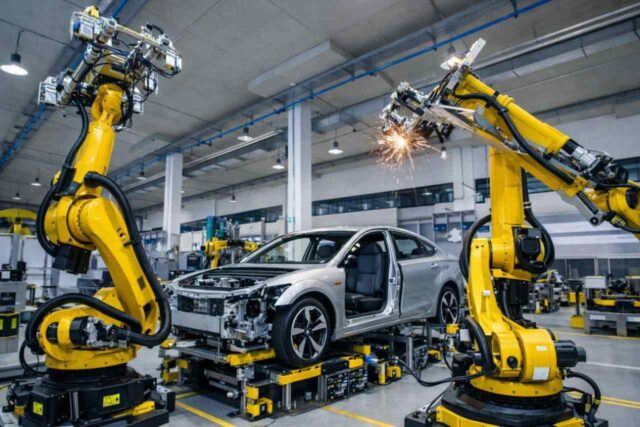
The automotive industry is going all robotic, with many companies already having transformed their entire facilities into a lights-out operation as robots and automated machines continue to work. These interlinked robotic systems directly slash labor by 25-35% and also work significantly faster and with fewer errors than an ordinary production line managed by humans.
Several automotive companies in 2026 are already using advanced industrial robots (heavy robots) for dealing with bigger parts like welding chassis. And cobots are used alongside humans in their workspace to perform flexible jobs like inserting battery modules and wiring for EVs.
Such collaborative working trends in the automotive industry have introduced lower labor costs and increased output rates. To deploy, start with assessing needs first and choose robots based on payload and their compatibility with the ERP and AI systems in place. Once selected, deploy one or two by using offline simulation software to test paths for two to three months and deploy factory-wide after staff training.
4.2 Real-Time OEE Tracking
Even with such advanced robotic and AI systems, monitoring Overall Equipment Effectiveness, or OEE, remains equally crucial for cutting down costs. A real-time dashboard collects all the data from these robots and machines with IoT sensors and analyzes the equipment’s speed, downtime, and rejects.
This OEE tracking predicts and flags any potential errors in the system to prioritize its maintenance to avoid long downtime of the entire assembly line. The final metrics that managers check are performance up to 95 percent with no slowdown.
Others are quality standards if they are being met (up to 98 percent) with minimal scrap and availability of operation with less than 10 percent downtime. Their vibration analytics avert 20% breakdowns in a production cycle and can significantly reduce downtime for companies.
4.3 Blockchain and Digital Twins
Such an automated and collaborative system requires its operations to be based on tamper-proof records and a trackable information system, which is done through blockchains and digital twins. Blockchain systems are used by automotive companies to avoid tariffs by using origin information in their cars.
Digital twins convert the traditional manufacturing of automobiles to a system that becomes proactive by nature and works by first testing scenarios virtually. This doesn’t halt the entire line if something goes wrong, but instead simulates a complete layout of changes, robot paths in service, or even takt time adjustments between them to spot inefficiencies.
This practice can easily identify any potential idle time between production of different parts of an automobile and can also schedule maintenance during off-shifts in case of any spotted wear and tear, minimizing long downtimes leading to losses.
4.4 Nearshoring and AI Forecasting
In 2026, automotive companies are increasingly relocating their strategic suppliers and production facilities closer to key markets, which are more important to them, including regional clusters of Europe, North America, and Southeast Asia. This is making their supply lines much more stable by cutting down logistics expenses, tariffs, and associated risks.
Moreover, companies are now using AI-powered demand forecasting and inventory optimization tools to make accurate decisions based on market conditions, all of which are being observed to cut down costs of warehousing from 5 to 10% in annual operations.
Alongside savings, companies are now also becoming more responsive as proximity to markets allows faster adaptation to demand shifts and regulatory changes. And finally, several automotive companies are now receiving enhanced customer satisfaction and improved product availability due to nearshoring.
4.5 Sustainability-Driven Material Optimization
This year, the automotive industry is increasingly regulated in its production practices and is pushed towards circular economy models. Companies are now using AI systems to select bio-based and recycled materials, which is slashing raw material costs from 15 to 25% this year.
Common examples of such materials include carbon-fiber composites from waste streams, which are recycled and used again in different automobile parts. Such a trend of green incentives in the production of automobiles is also attracting eco-conscious buyers and is saving them costs in their operations.
5. Checklist of Cheap but Resilient Manufacturing
This year’s industrial checklist of manufacturing cost reduction and resilient operations starts with auditing suppliers, giving them a risk score, and maintaining at least three approved suppliers per critical part of a product. This applies most to semiconductor items being used, EV battery cells, and chassis‑level components. If one link in this supply chain fails, the entire production can quickly reroute without a full line stop.
To detect any anomaly in supply chains, use AI to predict future demand and any problems that might affect it. Such systems use sales data, macroeconomic signals, and even weather or regional events to monitor any factor that could affect your production.
Next, use blockchain tech to track your goods in the supply chain. From raw materials to finished subassemblies, the entire operation should carry details of origin, handling conditions, and compliance certificates. This practice is already a standard working model of the automation industry.
Next, push to nearshoring to reduce delays, as this will cut freight expenses, shorten lead times, and make the network used to transport materials less vulnerable to ocean-lane disruptions, which is the case in 2026.
Keep stock buffers to avoid delays, not excessive inventory, but calculated safety stock tuned by AI. And finally, make the system resilient against disruption by using digital twins, and optimize the entire operation with small, continuous improvements.
6. JETTEST for Reliable Automotive Testing
All the above suggested trends are evidence-based practices and are already proving to bring positive results for manufacturing cost reduction in the automotive industry. Having said that, for end-of-line perfection, businesses need an ecosystem of reliable testing equipment and related services to verify the direction of the intended goal in the workflow.
This is where JETTEST is helping the global automotive industry with its full suite of performance testing and environmental stress screening test ecosystems. From the portfolio, the first one is JETTEST’s motor driver auto test line, which is designed to seamlessly automate functional and environmental stress testing of traction‑motor controllers and domain‑control units well before they reach assembly lines.
These lines are aimed at reducing total manufacturing costs by reducing scrap rates in the assembly lines to avoid warranty-type failures and reduce line-down events. The next one is the OBC power burn-in system from JETTEST, which is designed as a new‑energy‑vehicle value stream that helps companies reduce logistics write-offs, service-network overhead, and field‑returned modules.
These lines work by creating a monitored closed loop in which a high‑throughput test environment is created for onboard automotive chargers, running them under elevated temperature and electrical load to screen for weak components. It verifies whether the product in check has reliable soldering quality and maintains overall claimed functional performance.
These two testing platforms along with JETTEST’s other offerings in the portfolio create a complete ecosystem of automated testing workflows which turn end-line inspection routines into a continuous quality and cost reduction engine.
7. Wrapping up
Automotive manufacturing cost reduction in 2026 isn’t about one magic fix but is more about combining lean thinking, smart automation, and digital diagnostic tools like JETTEST into a single, connected system. By embedding JETTEST diagnostics at the end of the line, companies turn what used to be pure inspection into an active data‑driven engine for preventing failures and saving costs.