
1. Introduction
Almost every global survey firm is pointing towards robust and gradual growth for industrial automation industries linked with precision manufacturing, digital twins, and energy‑efficient production. This transformation is not happening alone; it comes with higher quality requirements, growing sustainability pressures, and stricter global regulations.
To cope with these challenges, companies adopting modern operational frameworks have to look beyond shiny robots/cobots and automated control systems. This includes emphasis on smarter test workflows and connected production data.
Within this broader automated drive, industrial motor testing is emerging as a critical enabler of quality assurance, predictive maintenance, and compliance with increasingly stringent energy and safety standards. Firms that fail to integrate modern motor test systems into their automated production and service workflows risk higher scrap rates, unplanned downtime, and lower resilience to supply chain volatility—for example, a single defective motor can halt production for days, making it impossible to meet tight delivery deadlines amid global component shortages.
We are exploring here why the link between industrial automation industries and motor testing has become even stronger in recent years, the key drivers of this shift, and the latest technology trends in this landscape.
2. Motors in Modern Industrial Automation
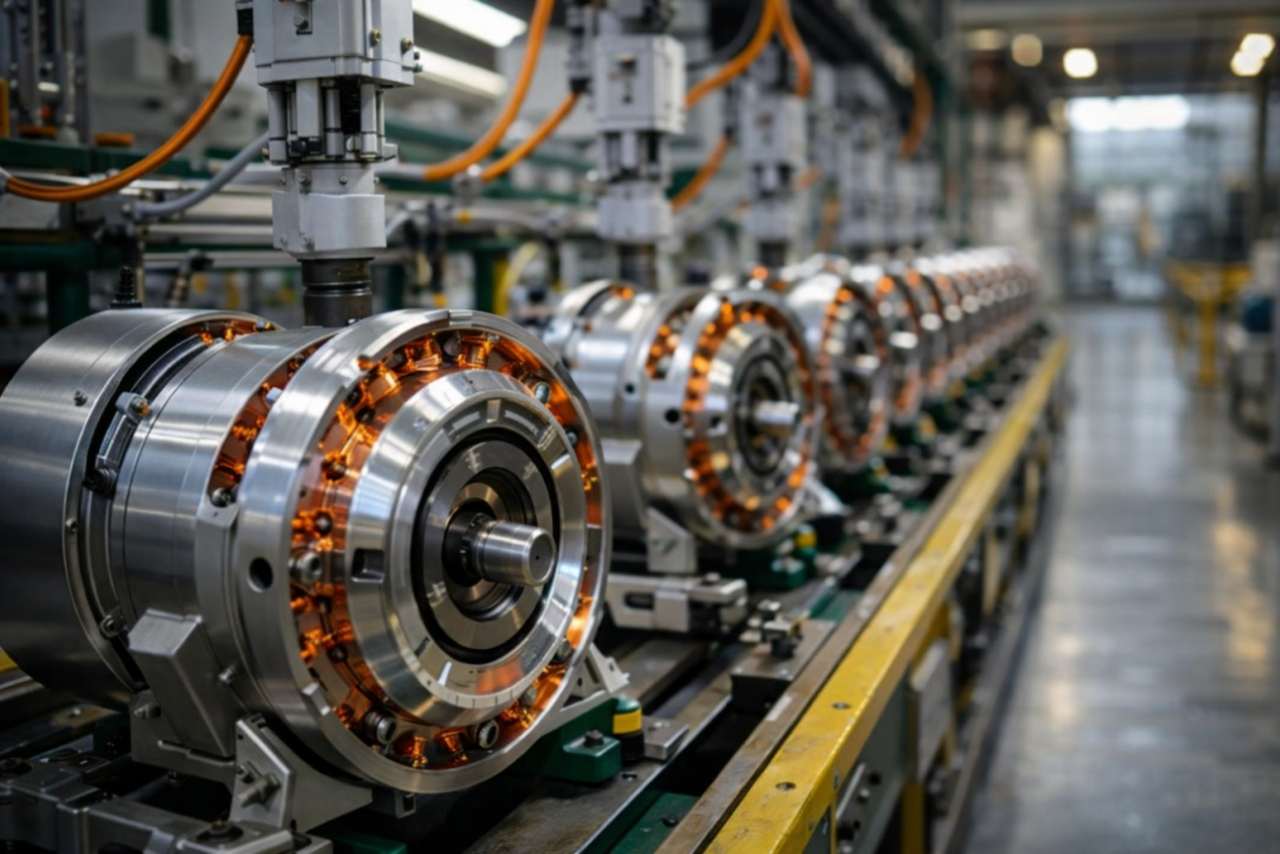
Advanced robots, PLC systems and control software often get more attention than industrial motors, but none of these systems can work without motors—they are the core power source for all automated equipment.
Their ability to translate electrical energy into necessary mechanical motion is used virtually in every automated process of an industrial setting. They are used as tiny servo units, often in pick-and-place robots for automated systems (rated from 0.1 to 5 kW), and super-heavy-duty induction motors rated over 100 kW.
In this wide spectrum of motor deployment, a single malfunctioning unit is catastrophic; all the robots start to stall, conveyors jam, AGVs drift, and CNC spindles vibrate. Keeping such worst-case scenarios aside, how smoothly and efficiently these motors operate directly determines the overall success of automation.
3. Trends of Automated Motor Testing
3.1 In‑Line Test Systems
These systems represent the gold standard for modern production and are designed to directly integrate into assembly lines. This enables easy validation of working indicators for all the industrial motors deployed at key production stages and does so without slowing throughput. Such a system also avoids any potential handling damage to motors, eliminates bottlenecks, and catches hardware problems right in the real-world scenario.
These systems essentially work at several checkpoints for a motor unit: post-winding insertion, pre-final casing, after rotor balancing, and end-of-line. Robotic handling arms with servo-driven grippers achieve 3-8 second test cycles, processing 800 to 2,000 motors/hour across 50+ variants, all without manual intervention. Integrating them allows manufacturers to maintain high throughput in their production lines while ensuring consistent quality assurance.
3.2 Predictive Maintenance & IoT
Modern automated facilities now commence motor testing within a predictive environment, which takes away all the downsides of traditional testing routines, which used to verify only current performance. In this new automated setup, IoT connectivity is used to collect large operational datasets of motors, including their electrical signatures, thermal responses, dynamic load behavior, vibration profiles, etc.
Such data sets are analyzed using advanced predictive analytics models with the help of AI-powered systems to identify hidden abnormalities linked with motor operations well before failures occur. This approach significantly reduces unplanned downtime and extends equipment service life.
3.3 Burn‑In & Aging Test Platforms
These testing routines are designed to test motor reliability and monitor its performance degradation over time. For this, the motor is exposed to extended high-stress conditions in a controlled environment that mimics real-world operating profiles, simulated using programmable thermal chambers, load banks, and vibration tables.
This testing routine is especially important for large-scale industries handling mission-critical automated systems, where the reliability of industrial motors directly impacts their production continuity and safety compliance.
3.4 Software‑Defined Tests & Data Analytics
Instead of relying just on fixed hardware configurations, software-defined testing platforms are used so that industries can adapt to multiple motor types and their testing requirements. These include no-load performance, temperature rise, locked-rotor torque, partial discharge analysis, and efficiency mapping.
To carry out these tests, powerful industrial PCs and embedded controllers run software-defined tests, which are designed to deliver agility and future-proofing with infinite configurability without physical modifications. Such software suites significantly help achieve efficient motor maintenance, covering from small servo units to large industrial drives.
3.5 Standardization & Interoperability
In 2026, the automation drive is in full swing for most of the large- and medium-scale global manufacturers. As industries become connected in this automated landscape for motor testing, the need for standardization for smooth integration between test systems, enterprise software, and production equipment is becoming more crucial.
OPC Unified Architecture has emerged as a standard interface to boost compatibility, security, and platform-independent data exchange. This interface maintains test results as structured node sets in which motor serials are mapped to UA objects containing more than 200 parameters with semantic metadata.
Similarly, EtherCAT enables real-time synchronization (with less than 1 µs jitter) for multi-station in-line testing, and PROFINET is designed to support Profisafe to maintain SIL 3 safety-rated operations in a facility. Industry data shows these universal standards can reduce global system integration time by over 78% and speed up new production line deployment by 22%.
3.6 Vibration & Noise Testing
Vibration and noise testing are directly linked to the precision and longevity of automated systems, as they analyze resonance risks in industrial equipment. For example, the harmonics of a motor that can potentially fracture its housings are mapped and analyzed with the modal hammer testing technique within a common range of 5-10 kHz to carry out modal analysis.
Moreover, advanced signal processing techniques like envelope analysis use 32-channel accelerometers. This hardware is designed to extract ball-pass outer frequencies to spot gear-mesh faults. Similarly, hemi-anechoic chambers are used to measure airborne and structure-borne transmission for a motor unit.
Source path contribution analysis can further distinguish between noise from air gap flux cutting and bearing whine. Modern testing routines use robotic microphone arrays that quickly create 3D sound maps for design iteration.
3.7 High-Voltage & Insulation Testing
Industry statistics indicate that insulation failures account for more than 55% of all industrial motor field returns. To address this critical issue, high-voltage and insulation testing are used to validate motor insulation integrity and long-term reliability. In such tests, the motors are checked for any particle discharge that doesn’t announce itself with smoke. Instead, they erode dielectrics over the time span of 6 to 18 months and eventually lead to winding failures.
These testing routines are designed to carry out dielectric validation across production and reliability profiles, along with surge testing, which can simulate real-world VFD spikes. Motors in normal operation show identical phase-to-phase ring patterns, but the faulty ones are filtered out with the help of comparative surge analysis, as they show 2 to 8% frequency shifts.
Similarly, Hipot and DC IR testing are used to scale for production, which are done through multichannel systems that can test several motors simultaneously. All of these tests are managed through non-contact capacitive probes and robotic positioning for hands-free connection.
4. Deployment of Automated Motor Testing
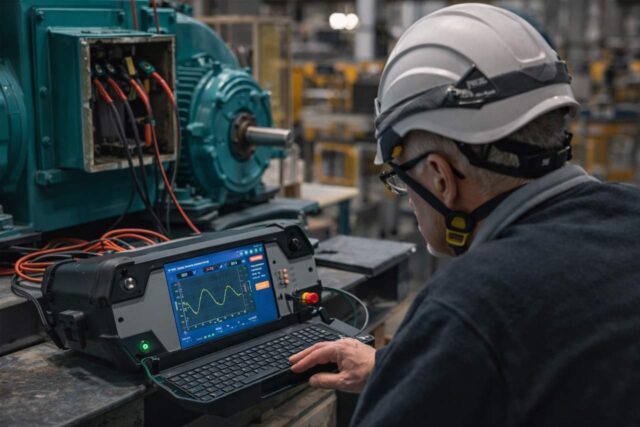
As medium and large-scale industries rapidly adopt AI-driven production workflows and connected industrial ecosystems, testing routines are evolving in parallel to meet these new requirements. This is also true for motor testing, as companies are now using automated testing routines to monitor these machines.
These new modern tests explained above are a much more effective way to reduce malfunctioning risks before equipment reaches the production floor. Smart manufacturing infrastructure is now using embedded motor testing systems in its workflows instead of deploying them as standalone inspection stations.
This means that a facility’s manufacturing execution system and enterprise resource planning software can maintain real-time communication between production equipment and testing systems, which helps them spot defective batches in their production lines, compare production trends across other facilities, and effectively optimize maintenance schedules for such motors using centralized operational data. This becomes extremely useful in high-volume production environments where rapid throughput is not compromised while maintaining strict QC checks.
5. Cost-Benefit of Automated Motor Testing
5.1 Direct Cost Savings
Traditional manual testing routines required at least 2 to 3 technicians per shift to carry out the entire procedure, which has now changed to one supervisor overseeing automated testing for at least four motor units simultaneously. This results in a 6 to 8-fold increase in operator productivity and significant direct cost savings.
Industry surveys in 2026 show that automated inline testing can reduce rework rates by 62% and catch over 98% of defects right at the production source. Automated motor testing systems in production lines are also significantly reducing unplanned downtime and warranty/service costs.
5.2 Compliance Acceleration
Automated test reports satisfy 100 percent of IEC 60034, UL 1004, and ecodesign requirements, eliminating 4- to 8-week certification delays. Manufacturers access premium markets and government incentives via energy rebates. For manufacturers exporting to Thailand and other Southeast Asian markets, export rejection rates due to non-compliance can drop from 12% to 0.8% after adopting automated testing. This is crucial for the EV industry, where tough competition and strict compliance requirements are non-negotiable.
5.3 Indirect & Strategic Benefits
Beyond higher throughput and greater efficiency, such platforms deliver additional strategic value for industrial automation industries. They enable data-driven continuous improvement cycles. Industry practice shows that SPC analytics can trace 82% of yield losses to 3 core root causes within 90 days, delivering 16% quality improvement in the second year. Digital twin integration cuts new product validation time by 41%, shortening time-to-market by 3 months. Cross-facility benchmarking can further increase global production yields by 11%.
6. JETTEST for Automation Motor Driver Testing
While industrial motors are the core of automation, their performance and reliability are entirely dependent on properly matched and calibrated motor drivers. A faulty motor driver can cause the same catastrophic production downtime as a defective motor, and it is equally critical to test these components thoroughly before deployment. Therefore, specialized motor driver testing platforms are equally critical for ensuring stable operation of high-throughput automated production lines. Generic testing setups often fail to meet the speed, precision, scalability, and environmental adaptability requirements of modern automated facilities—especially in Thailand and Southeast Asia, where high temperatures and humidity put extra stress on electronic components like motor drivers. JETTEST offers industry-purpose-built automated testing systems that meet all these requirements.
JETTEST’s Motor Driver Auto Test Line is purpose-built for high-volume automated production. It supports inline electrical and functional testing of various motor drivers, and can seamlessly connect with your factory’s MES and ERP systems via standard interfaces like OPC UA and EtherCAT—exactly matching the Industry 4.0 trends we discussed earlier. This integrated system supports fully automated production testing workflows that significantly improve efficiency and ensure consistent product validation across multiple operational stages.
Similarly, JETTEST’s Automatic Motor Driver Burn-In Line is designed for dedicated burn-in and aging testing of motor driver systems. It simulates continuous high-stress operating conditions, including high temperatures up to 85°C that are common in Thai factories, to identify early-stage component weaknesses before products leave your factory.
JETTEST has over 18 years of experience in industrial testing equipment, with local support teams in Thailand to provide fast on-site installation, training, and technical assistance.
7. Wrapping up
Today’s industrial automation industries can face major disruptions if the motors or motor drivers powering their automated systems malfunction. In today’s AI and IoT-powered industrial era, advanced automated motor driver testing systems from JETTEST are essential for ensuring long-term equipment reliability, stable production, and compliance with international standards.