
1. Introduction
According to the latest data from IRENA, global installed photovoltaic capacity exceeded 1.5 terawatts by the end of 2025, and is projected to surpass 3 terawatts by 2027. This number is expected to grow even further with the help of the automation of manufacturing processes. Such a huge transformation in the energy production industry demands extreme efficiency in its production processes to keep up with these numbers.
But the post-2025 supply chain disruptions, rising energy and raw material costs, and stricter ESG regulations are big challenges for manufacturers to maintain such efficiency and match higher global demand.
In this uncertain business landscape, automation is safeguarding companies from such disruptions and is reshaping traditional solar production practices, from wafer slicing to final shipment. By the end of 2026, more than 85% of the top fifty global PV producers will already be engaged in full-line automation (according to BloombergNEF), leading to an Industry 5.0 solar ecosystem of manufacturing.
In this article, we are going to review how automation is helping businesses and is successfully streamlining manufacturing processes, delivering 25-40% cost reductions and enabling production of modules with defect rates as low as 0.1%.
2. Benefits of Automation in Solar Industry
Automation in this industry stands as the linchpin, which not only increases throughput but also accurately anticipates workflow disruptions, right from polysilicon tariffs to raw material spikes used for solar panels. Here are five areas where such systems are significantly impacting:
2.1 Module Assembly & Testing
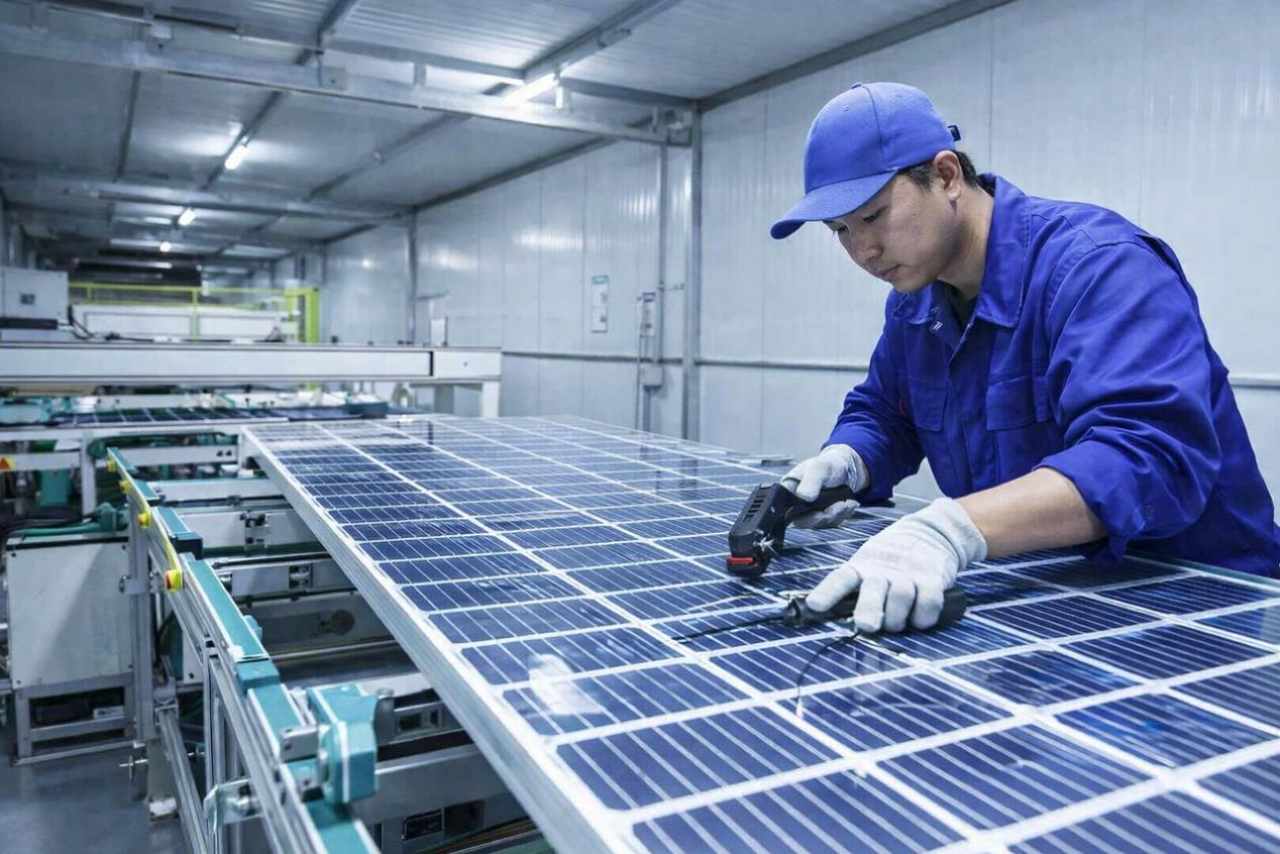
One of the most common manufacturing errors (recorded somewhere between 5 and 8 percent) in the solar industry is microcracks in module assembly, which are linked with manual alignment done in traditional factories. Automation drops it to 0.2 percent (per SEMI 2026 standards).
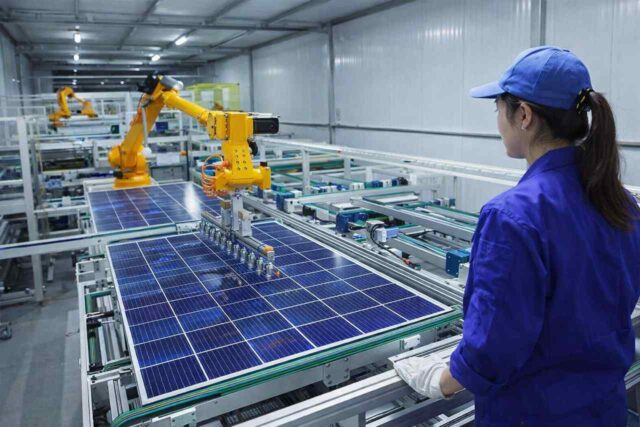
With advanced automated assemblies, layup stations use vacuum end-effectors to pick up and place sheets of special glass, along with Ethylene Vinyl Acetate (EVA) encapsulants and their backsheets. All this happens in a few seconds, making the entire process error-free and blazing fast. Such automated systems not only increase output but also reduce mistakes in production and improve panel quality, which is always desirable.
2.2 Quality Inspection & Defect Detection
These automated manufacturing plants are equipped with hyperspectral cameras and deep neural networks, which are designed to use UV to IR wavelengths in their optics, which can easily unmask snail trails before they metastasize.
Moreover, inline robots (plasma cleaners) are used to remove tiny contaminants from the surface of solar modules with ionized gas. This defect detection hardware can perform with extreme efficiency, reaching 99.99 percent accuracy due to its advanced machine learning algorithms. This is a significant increase from 15 percent of subtle defects, which are reported to be missed during human inspections.
2.3 Maintenance & Cost Efficiency
In such autonomous operations, Internet of Things (IoT) sensors & digital twin implementation enable the foreseeing of any breakdowns in the entire factory. McKinsey’s 2026 solar analysis mentions that such autonomous factories are already witnessing 70 percent less downtime in the annual manufacturing operations, all because of predictive maintenance.
Managers and engineers use software like Unity or Siemens NX to create digital twins, and their Bayesian networks analyze patterns in the IoT sensors, which can be either signals bearing wear or pointing out potential faults of the future. The latest automated factories feature sub-millisecond latency, which is used to integrate weather data for proactive production ramps.
Such arrangements are recorded to directly slash labor costs by 60 percent, with a rough estimate of an increased throughput of 60 percent. Such numbers are making heads turn, especially after post-2025 polysilicon hikes.
2.4 Warehouse Handling & Logistics
More throughput needs better packaging/shipping to keep things smooth, and this is where palletizers come in, from automated setups that can easily stack 500 modules/hour with RFID/QR tags embedded in check, which is crucial to maintain blockchain provenance for ESG audits. Such facilities also use predictive analytics to forecast orders from utility tenders to arrange pre-staging pallets for JIT shipping.
3. Key Areas of Automation in Solar Industry
3.1 Wafer & Cell Manufacturing
The most important number solar businesses care for is “kerf loss” in wafer production of solar panels. With the help of new automated systems, it is now less than 1 percent, a significant reduction compared to those with no automation in place. In modern facilities, advanced robots handle all manual processes in diffusion furnaces and deliver uniform phosphorus doping for 24% efficient N-type cells.
These automated solar manufacturing facilities use smart machines with PECVD chambers that automatically put thin layers on the cell. Laser scribes can quickly draw patterns without touching the surface, and quantum-dot sensors can monitor the entire process in real time and compensate for heat-induced changes.
3.2 Module Assembly and Testing
Advanced robots can connect 120 half-cells every second with the help of high-resolution cameras and precise grippers. Such systems also maintain alignment of these cells within 0.1 millimeters, which is especially important for bifacial modules. Next, vacuum robots are used in lay-up stations, stacking glass and EVA sheets, followed by laminating in an autoclave under a precise set value of 1,500 Pa pressure.
This process is continuously tested through a highly automated system that uses electroluminescence imagers, which are error-free hardware that can scan up to 1,000 modules per hour to spot the tiniest cracks on the surface. Next, flash testers are used to simulate decades of continuous use of these panels to confirm that they can retain more than 85 percent of their specified performance.
This framework of operation is now being integrated with edge AI in the industry, which will add another layer of pure field intelligence in the manufacturing process. Experts point out that this will result in predicting long-term degradation from companies’ spectral data, which will allow manufacturers to extend warranties of solar products to more than 35 years.
3.3 Quality Inspection & Defect Detection
In 2026, automation of manufacturing processes now features hyperspectral cameras that are powered with advanced AI models designed to spot solar panel damage at the tiniest levels. Now, companies use plasma cleaners, which are integrated right into the production line to deal with the common issues of snail trails.
Some large-scale operations are also using special drones that feature thermal payloads to patrol overhead and can seamlessly fuse data in real-time edge clouds for 360° scans. Such QC is pushing warranties for years and is also dropping failure rates in the field.
3.4 Packaging & Shipping
The most common visualization of an “automated” manufacturing facility is shiny, smart robots that effortlessly palletize hundreds of solar modules every hour. These modules are tracked with RFID tags for easy tracking in such a fast-paced manufacturing workflow.
Once ready, automated guided vehicles take these pallets away to the designated warehouse with all safety measures in check. Once stocked in their specified space, the ones that need to be shipped are packed in foam applicators through much more “sustainable” packaging with waste cuts reaching as much as 50 percent.
3.5 Factory Monitoring & Predictive Maintenance
Automated factories of solar modules now simulate digital twins, which help managers see problems coming and plan better before they happen. Combined with this software assistance, vibration sensors are attached to conveyor belts, which feed their sensing data to machine learning algorithms.
Both this sensing data and digital twin assistance help solar companies to predict failures up to 72 hours in advance and also reduce downtime, resulting in a 70 percent drop, which is already saving huge costs in 2026.
4. Data‑Driven Smart Factory Integration
The abovementioned features of automated manufacturing require ultra-fast and lag-free communication enabled by fast bands of 5G & 6G networks plus blockchain for secure records. These high-speed connectivity and intelligent AI control systems use operational data in solar factories to train AI models, which adjust etching times to squeeze out an extra 0.5% efficiency.
The latest generation of solar factories employs federated learning, which enables management to share their own AI insights of operational data with other partners in the industry and is done all without exposing private data, following strict rules like GDPR 2.0.
5. Challenges in Implementation
The upgrade of solar manufacturing with AI and automation looks promising, but in reality, the deployment path is not smooth. The most common challenges in the automation of manufacturing processes in solar landscape are as follows:
5.1. High CapEx
Upgrading an existing setup to be automated or building a brand‑new factory line incurs significant costs, even for large-scale operations. Research and development for affordable solar automation is underway, but the automation journey remains quite expensive in 2026.
5.2 Integration Problems
Old factory control systems with legacy Programmable Logic Controllers (PLCs) are observed to only work partially or not work at all with modern automated systems for solar production. Such legacy systems face trouble communicating with the Industrial Internet of Things & are known to cause more than 20% of pilot automation projects to fail in the solar industry.
5.3 Skills Gap
According to a recent report from the World Economic Forum, more than 40% of global manufacturers lack the necessary AI talent needed for the successful automation transformation. This skill gap is also significant in the solar manufacturing industry and is one of the major factors slowing the adoption of AI technologies.
5.4 Cybersecurity Risks
As more and more solar factories are entering the digital landscape, they are also becoming vulnerable to external attacks. In 2025, such attacks were recorded to exceed 15 percent, leading to widespread shutdowns & financial losses.
5.5 Prone to Supply Chain Volatility
Geopolitical tensions, changing taxes and robot chip shortages defined the industry during the 2021 semiconductor crisis, showing how fragile supply chains of solar products can be. Even with smarter factories, businesses can fail due to supply chain volatility. Companies are diversifying their supply chains with AI vendor scoring as recent trade wars between big economies are hurting solar businesses all around the world.
6. From Pilot to Scale with JETTEST
The above-mentioned challenges can be manageable for large enterprises, but the new players in the solar industry can be hit hard and usually have limited resources to deal with any volatility in their operations. Another consideration is not to focus on better throughput but also to ensure that both efficiency and safety compliance are met at high yields.
For this, JETTEST, a national high-tech and “Specialized, Refined, Differential, Innovative” enterprise with 18 years of experience in new energy testing, ensures that this transition from pilot to hyperscale is seamless and maximizes return on investment. Our equipment is designed as a fully automated platform for functional validation of inverters, power conversion units & embedded photovoltaic control electronics, all handled in a way that mirrors actual field conditions.
This equipment is designed to pair with the system’s software and run tests to check inverter efficiency across a wide MPP range and other important specifications like overvoltage, overcurrent, and thermal protection behavior. Our exclusive energy-saving load technology achieves 80% energy recovery, significantly reducing customers’ long-term testing electricity costs. Designed to be used as an effortless, integrable tool, this equipment enables a repeatable, data‑driven test cell that feeds directly into Manufacturing Execution System (MES) & quality dashboards of solar factories. Our solutions have been widely adopted by leading manufacturers such as Growatt (Vietnam & Thailand), helping them achieve 70% lower field failure rates and pass local certifications smoothly.
7. Wrapping up
The benefits of automation of manufacturing processes in the solar industry are directly linked with significantly improved economic, environmental, and operational outcomes. But its deployment can be challenging, especially if not deployed strategically. To get the best results, pilot wisely, don’t ignore human-machine collaboration, and partner with trusted innovators like JETTEST to achieve maximum success in the automation drive of solar manufacturing.