

1. Introduction
Gone are the days when sleek electric vehicles driving by themselves were just considered science fiction. Today’s roads are already benefiting from the smart manufacturing technologies behind automobiles, as every day more and more EVs are gliding silently through bustling streets, dodging traffic and obstacles without a human hand on the wheel.
These futuristic yet already accessible electrified autonomous cars are propelled by the invisible blend of advanced manufacturing technologies working for them. But what is that invisible force, and what really powers these marvels?
These cars are now a reality, not just because of shiny tech built inside them, but also because of the factories that mass-produce these cars, which are now reimagined as intelligent ecosystems of new interconnected technologies.
In this explanation article, we explore the foundational pillars of smart manufacturing and real-world synergies of this new revolutionary tech standard and the future/challenges of the smart EV industry beyond 2026.
2. Core Pillars of Smart Manufacturing Technologies
2.1 Advanced Robotics & Cobots
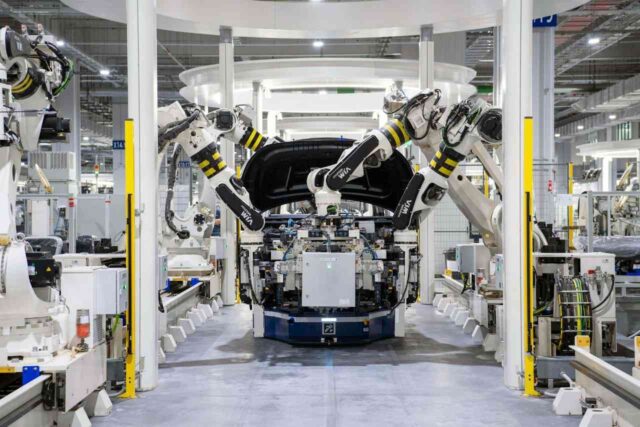
Robots are now finally getting rid of their clunky shells, as the new generation of robots is designed to become a true workforce of smart manufacturing. The new generation of robots wield tools with human-like instincts and movements, flipping welds or inserting Light Detection and Ranging (LiDAR) units without fatigue on car production lines. Cobots are becoming the norm, as they are now a reliable sidekick working elbow-to-elbow with the human workforce.
2.2 IoT & Real-Time Connectivity
Smart manufacturing runs on a nervous system built on the Internet of Things, which is essentially an interconnected link of millions of devices. These devices are designed with sensors that are embedded in every bolt & conveyor and are capable of whispering status updates. These updates include temperature spikes, part wear and tear status, vibration status, and more.
2.3 Digital Twins & Simulation
The physical assets of factories get a digital twin, which is used to simulate the entire EV factory. This simulation is then used to run all kinds of “what-if” scenarios like a production line tweak without real downtime.
2.4 Big Data Analytics for Optimization
Big data analytics is the crystal ball of such advanced manufacturing standards, as it serves as a platform to forecast what is needed to optimize operations. Companies use it to crunch production logs in their EV manufacturing facilities, get weather feeds for supply movement, related supply metrics, and other important data to optimize yields.
2.5 Cloud Computing & Cybersecurity
Such a manufacturing system requires monitoring, data analytics, and action against it all in real time. This is where cloud computing acts as a pillar, as it is vital for real-time data processing of the entire operation. These computing systems enable global connectivity with remote monitoring and control of manufacturing operations while feeding live metrics to the cloud, where AI-driven analytics engines process them within milliseconds.
3. Smart Manufacturing & EVs
A successful operation of smart EV factories in 2026 is being achieved by following three basic, well-defined, and traceable objectives. First, collecting as much relevant data as possible from the equipment in service; second, deep AI-powered analysis of this data to generate useful information to be used for business decision-making as well as for EV factory operations; and finally, acting on process automation, informing business strategy, and system optimization for the long run.
Such an objective framework is supported by five technology pillars (as mentioned above), which complement productivity as well as give more control over the entire EV production business.
3.1 IoT & Real-Time Connectivity
An informed system of connectivity (explained above) powered by IoT and 5G/6G network speeds in the manufacturing environment is a backbone for the latest automobile companies, where IoT helps achieve many goals. For example, such a system tracks car battery cells from raw lithium to the final assembly pack installed on the vehicle, ensuring 99.9% uptime from production to installation.
For such a system to work with utmost efficiency, latency is a crucial factor. This is where 5G (soon 6G) enables these sensors to stream data at super-fast speeds with virtually no latency. This enables such sensitive systems to predict failures from 1,000+ machines before they halt production lines in automobile factories.
On the road, these cars are connected to their servers, enabling autonomous driving with real-time responsiveness for instant on-road decisions. Moreover, modern factories can even deliver car parts just in time, cut downtime by more than 50 percent, and also help with compliance with certifications like CE for global automotive integration.
3.2 Precision Assembly Lines
This is where the real magic manifests in the synergy of automobiles and smart manufacturing technologies of today, as these new “precision” assembly lines truly revolutionize the industry. Such lines are powered by intelligent and fully autonomous robot swarms, like bees, all working 24/7 without getting tired to layer graphene composites for the lightweight chassis of modern cars, which they need for more than a 500-mile range.
The precision here is not just coming from the scale and automated nature of such production lines but also the accuracy in their production activities. These lines are designed to weld at 0.05 mm accuracy, embedding radar arrays flawlessly with vision AI inspecting 100 percent of welds. Such lines yield almost 99.999% first-pass yield and are highly scalable, especially for car battery exports.
3.3 Supply Chain Optimization
Again, IoT comes into play for supply chain optimization of modern cars, as they play a pivotal role here too. Blockchain technology is used to track rare-earth materials and magnets right from the mines all the way to the car motors placed on the final assembly line. This predicts shortages of such materials with 95% accuracy and avoids supply chain issues.
This mine-to-market supply strategy is also adopted by BYD’s vertical integration, which is already delivering rapid global expansion for the company due to solid supply chain resilience because of such interconnected IoT-powered tracing systems. It also enhances manufacturing speed plus cost control.
3.4 Customization at Scale
New smart manufacturing technologies like AI-based generative design systems can now configure car interiors via customer apps and enable on-demand 3D printing of dash cams. This new smart manufacturing era makes it possible to design interiors as per customer requirements as they select advanced driver‑assistance packages and even choose bespoke sensor layouts of their liking.
Behind the scenes, the pillars of smart manufacturing are at work: Computer-Aided Design (CAD), robotic assembly cells, and AI-based quality inspection note what variations are made. Once done, all of their customization is translated directly into production‑ready work orders without manual reprogramming of the entire production line.
This system of interconnected technology is also used to get rid of thousands of prototypes traditionally made in the design process of new cars. Instead, now an algorithm, let’s say for a steering system, simulates a real-world scenario and tests the new hardware in VR through thousands of real-world varying conditions, resulting in huge cost savings for R&D.
3.5 Cybersecurity and EV Production
The central Manufacturing Execution System (MES) & cloud-based analytics monitoring the EV lines are interconnected through a network of power electronics test cells, battery management systems, on-board chargers, and related components. For such a dense and fast-paced production system, the cybersecurity of embedded electronics becomes non‑negotiable.
To be resilient against the continuous threat landscape in this modern industry, companies use durable test and burn-in equipment that carries out functional, electrical, and cryptographic integrity tests before integration into the vehicle.
4. Challenges and Solutions
The above fusion of smart manufacturing tech with the automotive industry, especially the EV production, looks promising, but every revolution comes with pitfalls as well. The biggest challenge is cyberattacks in such interconnected operations, where hacks creeping in with ransomware can cripple production lines.
Famous examples are JBS or Colonial Pipeline analogs in auto, and the recent total losses from such hacking attacks are reported to be more than 10 billion USD, according to IBM X-Force’s latest figures.
This is being countered with AI-driven anomaly detection and autonomous response systems that can quickly (within milliseconds) flag irregular data flows in their IoT neural network and launch countermeasures. Blockchain is also increasingly integrated, which adds tamper-proof ledgers in such smart manufacturing systems.
Huge upfront costs are keeping most of the businesses from diving into this smart manufacturing world, as a single smart line upgrade can cost between $1 million and $5 million, which daunts SMEs. ROI times are also longer, and integration with existing setups for large-scale companies can be challenging, too. Phased rollouts are the only feasible solution here.
Another significant issue is the talent and skill gap to run such facilities for EV production. This new Industry 4.0 & 5.0 demands engineers who are proficient in new AI systems, robotics, cobots, and advanced industrial data science. Yet global shortages of such talent reached 2.4 million unfilled manufacturing jobs by 2025 and are expected to rise this year.
5. EV Smart Manufacturing and Quality Control
In such fast-paced and interconnected manufacturing of automotives, quality control systems take prime priority to maintain Overall Equipment Effectiveness (OEE) of such continuous and highly efficient operations. This is where JETTEST comes in, which offers a complete portfolio of automotive electronics test and burn‑in equipment for core components used in autonomous and EV systems.
Product offerings like our automatic motor driver burn-in test line are designed to complement smart manufacturing environments while providing Controller Area Network/Local Interconnect Network (CAN/LIN) communication diagnosis and multi-channel parallel aging tests. These testing platforms verify the reliability of the electronics inside EVs well before they ever hit the road.
Our automated burn-in and Printed Circuit Board Assembly (PCBA) test systems are essential to make sure that every electronic control unit produced in a smart factory meets design specifications and passes compliance certifications. These testing platforms combine several core testing schemes, like environmental stress screening, multi-channel aging, and communication-bus diagnostics. All of them collectively minimize field failures and support compliance with global safety frameworks for EVs.
6. Wrapping Up
The EV and automobile industries as a whole are embracing the biggest shift in their operational frameworks since the advent of the modern automotive industry. The key advantages of smart manufacturing technologies for EVs include significantly improved data mining and industrial control. But this shift also comes with significant challenges, which are manageable.