
1. Introduction
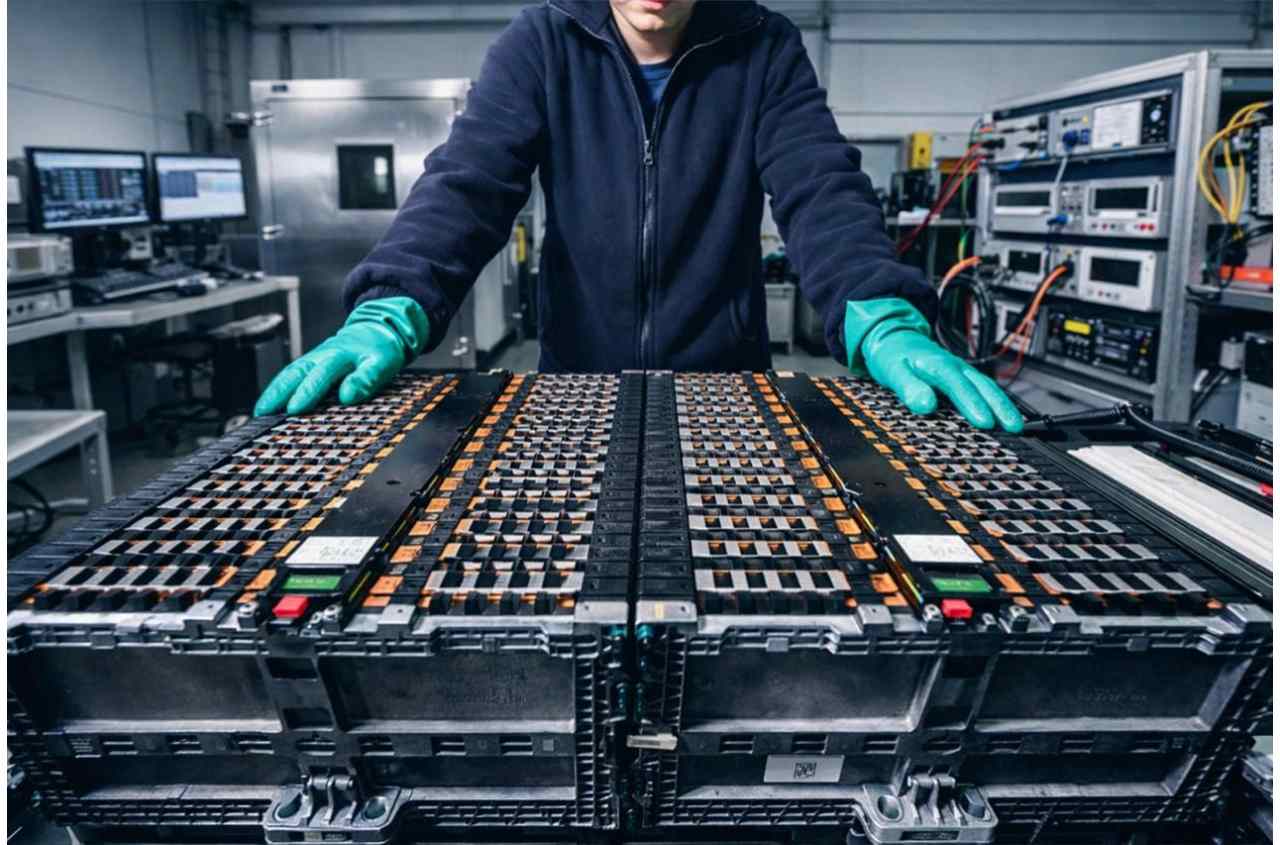
The battery management system in a modern EV is designed to manage systems embedded in software & hardware layers to make sure that the vehicle works in a safe environment and delivers expected performance. For EV manufacturers, battery management testing or battery management system testing is crucial and has to be validated exhaustively before it ever reaches the end customer.
This validation and testing phase is actually a long-duration cycling & aging process that mimics years of real-world battery use. This mimicification still runs for weeks or even months, especially when these tests are run in different temperatures, fault scenarios, SOC windows, cell chemistries, and newer versions of firmware installed in the vehicle.
Longer test cycles can easily push back the OEM’s program milestones and put delays in their production cycles for newer EV products. Here, we are going to go through five practical and real-world ways that are proven to compress BMS test cycles, but first, let’s revisit related theory.
2. Why Are BMS Cycles So Slow?
There are several reasons for it: the first one is the designed slow charge/discharge limits linked with batteries, which are done to make sure they run safely. Pushing the charging of battery cells too fast causes extreme thermal stress to the battery cells & compromises the test’s validity. The second is that to validate batteries, especially in a legacy test setup, multiple complete calibration cycles are required in the entire 0% to 100% capacity range.
The BMS also needs cell balancing time, which is essentially the time to easily and evenly transfer energy between cells to balance them. Similarly, thermal soak times are monitored to log the response of batteries to temperature fluctuation. All these test procedures involving battery physics and chemistry require time in an industrial setting.
3. Fixing Slow BMS Test Cycles
3.1 Replace Physical Cells With Cell Emulation
Modern EV manufacturers use advanced power electronics-based cell simulators that can simulate all the testing conditions with actual chemistry being involved. These simulators simulate a specific battery cell’s electrical behavior in terms of all the required parameters involved in aging tests, including voltage, current response, internal resistance, dynamic characteristics, etc. This happens as all the important characteristics in question are parameters that are being simulated in a model rather than something the actual battery hardware has to physically experience.
Such a setup enables engineers to quickly simulate and record how their BMS will respond across an entire aging curve of a battery under observation, including its beginning of life, mid-life, end of life & beyond. In real practice, EV manufacturers employ both physical and simulated conditions for battery management testing to get both iterative logic validation and final confirmation.
3.2 Optimize Test Sequencing
Another common reason that adds to slower speeds is redundancy in testing schemes with overlapping testing routines. For this, each battery test case should be carried out with a structured review of the test matrix in which only the tests with the intended fault condition to be found should be targeted.
Similarly, before planning a testing routine, dependencies should be mapped out in test cases. The ones that aren’t independent (the ones that share hardware, preconditions, and state) can be run together to save time. In this way, only the dependent ones are run in sequence.
3.3 Reuse Data Across Test Campaigns
To speed up the testing campaigns, a shared data/model library is developed, which saves time for aging testing. If the accumulated historical data of a certain type of battery’s internal chemistry has already been executed, it is saved in shared libraries to easily share and not waste time starting from zero when executing another campaign.
This practice of shared libraries is especially useful when a new BMS revision needs to be validated against previously known battery cell behavior rather than carrying out a whole brand-new cell characterization. EV manufacturers now put special effort into maintaining a well-organized data library that closes that gap between previous tests and the new ones in a separate campaign.
3.4 Scale With Parallel & Automated Test Execution
Modern workflows now use automated and parallel coordinated tests across multiple benches at once, which are all handled with automated testing equipment. These systems use special software that can effortlessly queue test sequences and accurately log results of test cases without manual intervention.
To make these parallel benches work even faster, continuous integration pipelines are used to quickly create & test BMS software against any change in a continuous feedback loop. This change can be new firmware of the BMS, a different set of designed test rules, or a change in the chemistry itself.
3.5 Use Model-Based and Simulation-Driven Validation
Model-in-the-loop testing is used to validate the BMS algorithm itself, and software-in-the-loop testing checks this algorithm against a simulated environment for a particular battery chemistry. This enables engineers to effectively test core logic in these simulations & also control decisions, estimation algorithms, and fault handling.
And all this runs in parallel without needing the physical hardware to be tested, saving a lot of time for the engineers while enabling them to catch early & obvious bugs, checking boundary conditions, and confirming basic control behavior. Modern EV manufacturers combine this framework of battery management testing with digital twin architecture to get even more control in exploratory testing for every new battery chemistry in development.
4. Putting It All Together: A Faster BMS Test Workflow
The above five fixes don’t work in isolation, as all of them are used to develop an end-to-end faster pipeline. This starts with SIL & MIL testing in place to catch basic logic issues early, before anything is actually implemented. Then, test sequencing with shared libraries; use of automated testing equipment & multi-bench parallelization creates a pipeline where physical bench time is saved.
During this implementation, knowing whether this pipeline is actually delivering is determined by focusing on a few metrics that matter more than others. These include test cycle times, test throughput, and test coverage, which are important ones as they help engineers make sure that the testing speed isn’t just coming at the expense of thoroughness.
5. Common Pitfalls in BMS Testing
5.1 Over-relying on emulation
Even though emulation is extremely helpful, especially in speeding up the battery management testing schemes we discussed above, it’s still all virtual testing, not the actual thing. Some parameters like thermal runaway propagation, newer and not tried before chemistry-specific failure modes & actual chemical aging mechanisms need to be monitored and validated through actual physical testing.
5.2 Improper dependency mapping
This is one of the most common problems leading to faster but inaccurate testing results. When running parallel testing routines, the dependencies in the testing campaigns have to be mapped out clearly and documented/logged properly. This will help engineers to avoid dealing with situations like unexplained failures in testing routines, which can make them waste engineering time chasing a problem that doesn’t really exist in the first place.
5.3 Data reuse without version control
As mentioned above in the five fixes, the fastest way to cut down campaign time is to reuse historical data of battery testing results of earlier campaigns. But it only works if the historical data belongs to the same BMS software and framework versions. If there is a new version, the difference between the two can easily result in different calibration or different fault thresholds.
To fix that, data is to be maintained with its own version of context that represents the actual conditions under which it was logged. For this, standardized techniques for tagging historical results are used, ensuring data reuse occurs only when the origin is relevant under new test conditions.
5.4 Biased towards speed metrics
Another common pitfall is to use the above-mentioned fixes to just achieve faster BMS testing speeds rather than also keeping the ample coverage in check. Modern manufacturers usually fix this by standardizing testing matrices to avoid any situation of bias creeping into their testing campaigns.
Management only focuses on emulation, maximum parallelization, & automation, but not on selecting a few tests to gain speed. A commutative test plan is created in which compromises are only made where duplicate tests, availability of historical data, and other factors are taken into consideration.
6. Automated Pack Testing with Jettest
In modern EV car manufacturing and related ESS industries, automated pack testing lines are heavily used to facilitate quick testing and enable accurate data logging of burn-in and aging cycles for battery packs. Jettest’s Final ATP Line for Energy Storage Packs represents this industrial adoption, which automates testing with MES-compatible data logging and helps engineers get even faster speeds during battery validation and testing routines.
Although it doesn’t represent the BMS validation platform and does not replace the emulation and smart parallel techniques we mentioned above, it does complement the above five fixes for the industrial battery manufacturers and helps them by effortlessly absorbing the burn-in & endurance testing workload. In this way, the management can allocate scarcer and much more specialized BMS validation resources & stay fully focused on the safety and core logic of testing that only they can do.
7. Wrapping Up:
In the modern industry, battery management testing & its test cycles are prone to bottlenecks. Most of them can be avoided with the above-mentioned fixes, and when applied together with further automated testing equipment/final ATP lines, a mature pipeline for testing, validating, and manufacturing modern batteries is formed.