

1. Introduction
Imagine a scenario: a vendor demos their flashy new generative AI agent to their client that can easily handle usual tasks like the usual support tickets, can effortlessly update lengthy records, and also drafts technical proposals in the twinkling of an eye. All this is pretty impressive, but what if someone’s query becomes, “I want this agent to be deployed as a complete system running as AI in manufacturing industry for my business,” or “How soon can we roll this agent company-wide?”
This mindset stems from their familiarity with SaaS deployment models, as those deployment working methods are much more easy, but they don’t apply to real world manufacturing industry of large scale. This is where agentic AI comes into this specific landscape, and in this detailed article, we are covering how agentic AI work, its direct benefits, and how it is changing the future of manufacturing industry as we know it.
2. Concept and Working of Agentic AI
Imagine again, you hire someone to reply to your emails, and every time he does that, it’s at your command. It is direct, obvious, and smooth. But what if you say this employee of yours “takes care of all the customer complaints”? This time, this employee should understand by himself that his boss is talking about the emails of customers and how to “take care” of them.
The taking care part is what the employee will figure out themselves, from knowing their email, what to write, picking the important ones among them, deciding which ones to reply to, and so on. This smarter employee is your agentic AI, and the one who was just replying to emails is traditional classic AI trained on usual ML and rule engines.
Agentic AI is a much more advanced multi AI agent system that can execute in-depth planning, deduce results by itself, and then take actions autonomously to achieve a goal it was asked to work on. Such a system doesn’t ask you to tell me what to do; instead, it asks you what the goal is, and it literally finds ways to achieve it.
3. Historical Evolution in Manufacturing

Not literal roots, but traces of a similar concept of agentic AI in manufacturing industry can be traced all the way back to the 1970s, when the early natural language called SHRDLU was developed by Terry Winograd. Then, similar systems were seen in XCON in the 1980s and then in multi-agent systems related to supply chains. The arrival of digital tools in the 2010s fueled this concept and was pretty good at forecasting failures, but lacked action loops.
This changed when the ChatGPT boom from generative AI came along in 2023 and gave birth to agent frameworks (e.g., BabyAGI), and all this led to much more evolved AI in the manufacturing industry. The LangChain for MES integration was the very first one, but 2025 ignited this industry with releases like CrewAI and AutoGen.
Siemens’ Industrial Copilot agentized the very much needed PLC logic, and NVIDIA’s GROOT models bridged cognition and industrial kinematics, making another big leap in the industry. This year, D-Wave hybrids related to quantum annealing advanced agents are already solving NP-hard problems, which are also used by companies like Volkswagen to minimize production delays and further streamline their global logistics.
4. Key Applications in Factories
4.1 Better Supply Chain
Did you know that during the recent Red Sea disruptions due to the geopolitical instability, SAP APIs and its procurement agents simulated more than 5k new routes, which were done with the constraint of optimizing for CO₂ and landed costs? These AI agents did this all without planners and can also scrape more than 1 million feeds and auction via blockchain DAOs simultaneously.
4.2 Highly Effective QC and Inspection
Such systems are already powering applications (like vision-language agents) that use SAM2 models with a 99.9% F1 score. These agents can now process 4K video feed with 60 fps and can also generate AR holograms on HoloLens to be used by others at the site.
These advanced agents are very effective in detecting any anomaly through their vision and by using vibro-acoustic signatures, and all this input runs in a closed feedback loop to upstream casting flaws.
4.3 Better Production Scheduling and Optimization
Agentic AI systems have arrived to rescue traditional computers when dealing with factory scheduling puzzles. Unlike computers, these agents utilize Monte Carlo Tree Search, a much smarter search that uses quantum computing shortcuts and can easily reduce the production time of a facility to 45% even during the machine breakdown period.
They can also optimize the entire operation by pulling in and accessing data like live weather updates, fluctuating energy prices, and customer orders to smartly allot jobs in the cheapest time of the day and fulfill the orders.
4.4 Humanoid & Robotics Integration
Humanoid robots like Figure 01 and Atlas use special GROOT rules and are guided by agentic AI systems to learn new movements just by looking at humans (dexterous kitting) and later practice them in super-realistic virtual simulations. The tasks using such movements include picking, packing, sorting, etc.
This system works as a layered control system in which a top-level AI agent is usually the boss, which orders broader goals while the low-level agent does smaller chores related to that specific goal.
4.5 Real Results in Energy Management
AI systems called LSTMs are a type of AI technology that is designed to spot patterns in past data over time and is now used along with agentic systems to predict how much electricity a power grid will need in its future operation. The agentic AI asks different “what ifs,” like “What if the entire operation is ramped up, or what if a strong heatwave kicks in?”
Such what-ifs push the system to cut back on non-essential power use by using smart throttling of the entire power grid. Energy systems also use model predictive control, or MPC, to fine-tune their HVAC systems through reinforcement learning and save a significant amount of energy.
5. Challenges and Solutions
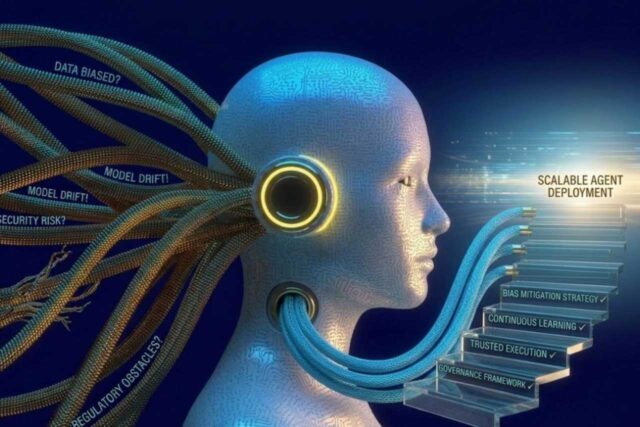
There are some roadblocks when it comes to deploying such evolved agents at scale, but smart fixes make them work smoothly. The most common issue is the data not being shared across data silos, which curbs these agents from working to their full potential.
This is dealt with using federated learning, in which these AI agents learn what is needed for their operation from data across factory-wide machines, and they do all of that without moving private info to one spot.
Another challenge is hack risks, especially when these agents are solely deciding significant matters like shifting production lines. To tackle this, zero-trust systems are used along with kill switches to make the system work in a safe environment. Moreover, quantum-proof codes are used to protect the system from any supercomputer attacks or hacking attempts of any form.
A common problem when dealing with agentic AI systems is the non-availability of skills to deal with them, but this is changing fast with no-code tools that can easily and quickly help manufacturing facilities upgrade their regular staff to AI handlers.
Many manufacturing facilities are still using old PLC systems that can communicate with newer agentic AI programs. For this, many middleware systems are developed, which act as a language translator between the two.
Latency in such facilities can cause serious damage; imagine a robot crashing in a split second, causing an exponential effect in production lines. Edge AI computing is fixing that, plus backups, both of which keep them going even during power dips.
6. Deployment Road Map
Deployment of agentic AI in manufacturing industry doesn’t happen in a single rollover but takes a step-by-step strategic approach, starting small with planning. This starts with the first deployment of SIMP agents, which are responsible for maintenance tasks in routine manufacturing and are tested for at least three months to establish a good amount of operational data.
Once that is done, then expand with multi-agent setups where such agents are doing the same thing but working together on different machines. This phase should last for at least 6 to 9 months or even more.
And then the final stage comes as the deployment of enterprise meshes, where the entire operation is interconnected through these agents. During this deployment, key factors to check are decision velocity (speed in queries answered per second) and autonomy index (percentage of tasks executed without human intervention). If they are off track, then private factory data is used by expert partners to fine-tune settings.
7. Safe Deployment of Agentic AI with Jettest
For manufacturing businesses to be successful with the deployment of such revolutionary AI systems, the availability of end-to-end testing infrastructure and expert skills at their disposal is extremely important. Jettest is the world’s leading platform to provide infrastructure purpose-built for testing and a safety + reliability layer for smooth deployment of agentic AI systems, especially for the manufacturing industry.
With Jettest’s wide range of products, businesses can run automated test scenarios while simulating real production scenarios in their manufacturing facilities. They are also used for continuous testing pipelines or CI/CD, which sets side-by-side, step-by-step deployment of these AI agents as discussed above.
Moreover, Jettest also ensures that all components communicate properly (reliable communication between different APIs and their data flows) during the deployment, which is extremely important in manufacturing facilities, as old machines or specific components are prone to not handling newer AI agents and their language.
8. Wrapping Up
The year 2026 is a transformative one thanks to agentic AI in manufacturing industry, which is bringing economic autonomy while lowering costs and helping them thrive against uncertainty. Agentic AI is your new driver of manufacturing business, while Jettest is its driver’s license and inspection system on its operational road.