
1.Introduction
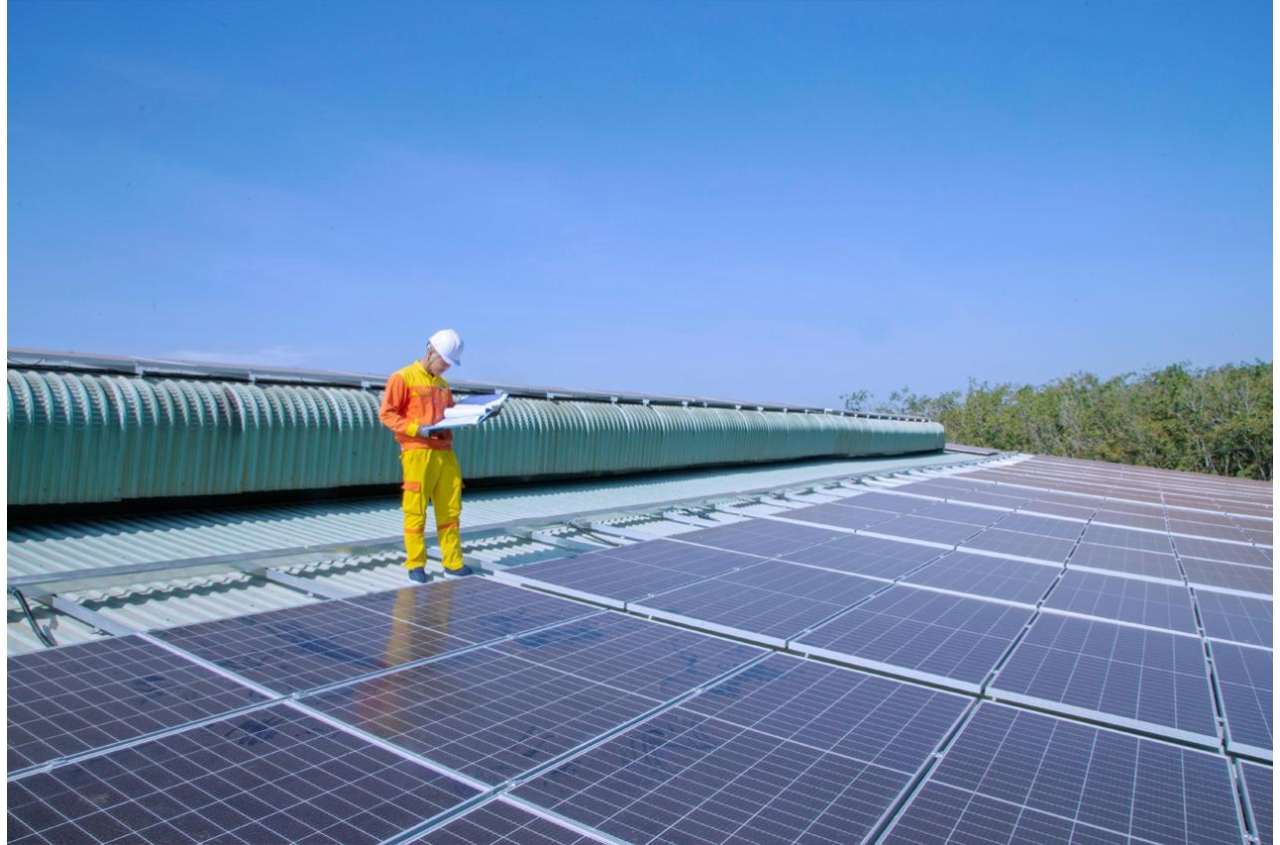
Among the fastest-growing manufacturing industries of 2026, solar manufacturing is considered to be at the top, driven by the falling costs of photovoltaic technologies and the need for an urgent transition to clean energy sources. To keep up with this pace, solar industries seek even more manufacturing process optimization to stay competitive.
But this specific industry has special challenges too: delicate materials, stringent quality requirements, and complex multi-step processes already complicate the situation of intense price competition in 2026. Manufacturers are now looking for ways to push for small improvements in energy consumption, throughput numbers, and yield rates, which can eventually translate into sizable amounts in savings. Below, we explored how these manufacturers are achieving these goals.
2. What is Manufacturing Optimization?
In essence, this optimization is all about tightening up the manufacturing workflows implemented on the floor. Managers look for what is slowing down production, what waste materials are coming out, and monitor the time to complete this workflow. They can also look at all these factors at once and find what hurts the consistency of these activities and then fix them one by one.
During such a manufacturing process optimization, only one aspect can be making a problem, or all of these workflow blocks can be off track. Moreover, this is not a program you roll out once. It’s ongoing work that needs time to analyze and implement fixes. Bit by bit, the optimization process makes the workflows cleaner and steadier towards targeted efficiency and margin goals.
In 2026, solar industries use live production data to implement such optimization changes in their manufacturing workflows, where smart machines, thousands of interconnected sensors, and advanced AI-powered software help implement these fixes.
3. Key Challenges in Solar Manufacturing Processes
3.1 Defect Detection
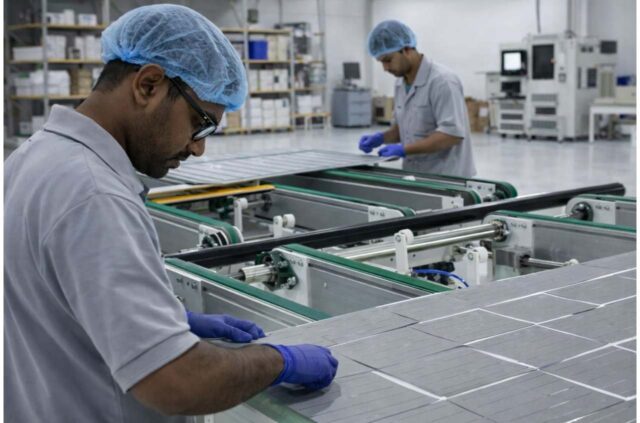
In a high-throughput double-shift working environment of a solar factory, detecting micro-cracks, electrical defects, and efficiency losses is challenging. Traditional manual checking has limited value to manufacturers and demands expensive AI-powered QC systems. Studies show that traditional manual inspection is linked with more than 50 to 70 percent defect rates.
3.2 Energy Intensity
Solar industries establish themselves as one of the most energy-intensive industries on the planet, as huge amounts of energy are required during production phases of wafer slicing, cell fabrication, and polysilicon production. In 2023, a staggering number of 112,000 to 224,000 GWh is linked with polysilicon alone, pushing solar manufacturers to seek significant optimization of energy consumption in their workflows through process tuning and efficient equipment.
3.3 Price Pressure
Due to the high demand for green energy all across the globe, the solar market is now intensely competitive and is pushing its manufacturers to constantly compete on price per watt. The only way they can do so is by lowering the costs of their manufacturing processes to maintain competitiveness in 2026, where global manufacturing capacity is above 1.8 TW with historic low per-watt prices of $0.07 to $0.09!
3.4 Capital Intensity
To develop facilities for carrying out wafer slicing, laser processing, cell deposition & automated QC testing along with clean room areas demands high capital to deploy. With $2 to 5 billion annual capital intensity recorded, only 50 percent is utilized. With such high cash flows and underutilization, management expects an early ROI, and for that, they seek maximum value from existing assets in their factories through significant optimization rather than relying on new equipment purchases.
3.5 Supply Chain Disruptions
Raw materials essential for solar manufacturing, including polysilicon, silver, aluminum, glass, and specialized chemicals, are prone to supply chain disruptions. Unfortunately, several regional conflicts of today have quietly disrupted the usual supply of these raw materials. For example, the disruption of silver, a crucial raw material for photovoltaic installations, is projected to drop 7 percent in supply due to supply chain constraints and rising prices.
3.6 Operational Challenges
Even with the arrival of advanced AI systems, companies still face common operational challenges like disconnected systems, inefficient manufacturing workflows, too many downtimes, & slow change to fix their challenges. Multiple studies done in 2025 & 2026 considered these issues and pointed out that more than 70 percent of digital transformation projects fail to meet their goals, & process optimization is the most significant way to deal with such failures.
4. Optimizing Solar Manufacturing
4.1. Consider Lean Manufacturing
The good old-fashioned core principles of lean manufacturing still remain one of the most effective ways to optimize solar manufacturing processes in 2026. The classic framework of lean manufacturing is still relevant and delivers a significant impact on final margins in the form of reduced cycle times, higher first-pass yield rates, improved employee engagement, and lower work-in-progress inventory.
There are overwhelming numbers of studies from all around the world done in the last few years that point to the fact that focusing on lean manufacturing helps companies to battle the current unpredictable business landscape. It does so by reducing their lead times by 20 to 50 percent while eliminating waste by mapping material/information flows, thus delivering measurable margin improvements.
4.2. Automate Repetitive Tasks
Using automated systems for repetitive tasks is “repeatedly” proven to have a positive role when it comes to manufacturing process optimization in the solar industry. Today, modern AI-powered systems can already easily & efficiently perform repetitive tasks that are labor-intensive and dangerous to handle by humans, such as hazardous material loading, heavy-weight cell placement, wafer handling, & module lamination.
In modern solar factories, human personnel in the facility are reserved for higher-value tasks while automated systems like automated guided vehicles and industrial robotics are increasingly used to optimize operations and increase throughput. In 2025, several major solar manufacturers reported more than 62 percent reduced defect rates in just one quarter, more than 95 percent average yield, and saved more than one million dollars in scrap/rework costs.
4.3. Integrate AI-Enabled QC
Higher throughput and efficient production are not the only benefits of AI-powered systems; they also handle quality inspection in solar factories. To optimize manufacturing processes, traditional QC done by humans has to be replaced with multiple stages of smart quality inspection systems.
These systems are equipped with high-resolution cameras & spectroscopic sensors, all running alongside advanced machine learning models. Advanced machine learning models are put to use, which implement quality checks by comparing what they analyze with a database of thousands of defect images. With this processing, this ML-powered system easily flags anomalies in real time and can detect issues like bad soldering, micro-cracks, etc.
4.4. Material Flow & Inventory Management
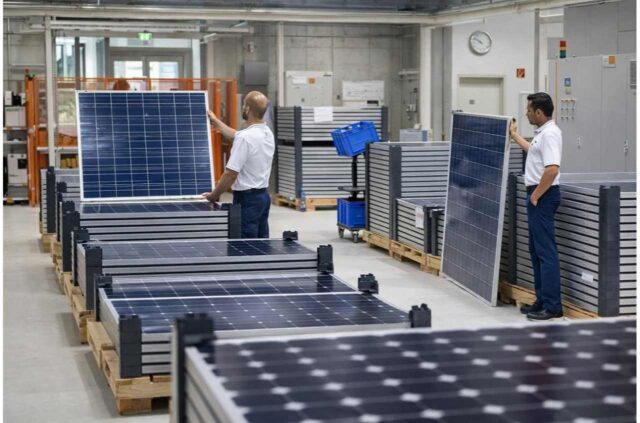
For solar manufacturing, raw materials like aluminum frames, polysilicon, silver paste, glass, & encapsulants, if not managed, can easily create operational bottlenecks & slow production. To deal with this, manufacturers use Just-in-Time delivery systems and AI-powered storage & retrieval systems with real-time inventory tracking working with RFIDs.
All these systems stabilize material flows by synchronizing material deliveries with production schedules with virtually no error due to automated material handling systems. A study done in 2022 funded by the Alliance for Sustainable Energy found that circularity improvements for material and inventory management in the PV supply chain result in nearly 50 percent reduced material intensity and waste.
There is also a solid amount of industrial research work done and published online in several journals that suggests that this kind of management significantly minimizes work-in-progress inventory, reduces storage costs, & also supports continuous production.
4.5. Process Tuning for Energy Consumption
As mentioned above, solar production remains one of the most energy-intensive manufacturing industries. To optimize the energy numbers to produce solar cells, companies use advanced energy management systems to fine-tune production parameters like cycle times and machine speeds to minimize energy waste while staying in acceptable QC ranges.
Surveys and studies suggest that using such systems to tune production parameters leads to higher productivity than current solar factory routines & also adds flexibility and higher product quality. To achieve the highest level of solar manufacturing process optimization in 2026, energy factors cannot be ignored, especially when the world is moving towards much more sustainable production practices in almost every industry.
4.6. Digital Process Maps for Workflows
Industrial manufacturing is going completely digital in this time & age, as traditional manufacturing workflows cannot keep up with the data analysis, process verification, & throughput rates of an Industry 4.0 setup. To keep up with the pace, management should focus on developing & maintaining a complete digital process map for their facilities so that they can have a clear visual representation of every step in the production process.
These maps represent the core decision points, handoffs, & quality checkpoints in a typical solar production workflow, which is itself integrated with central MES & other production systems. At each point in this map, attached are standard operating procedures, safety guidelines, and quality requirements, which makes it easier to ensure everyone works from the latest version of operational guidelines to reach the common goal of optimizing manufacturing processes.
4.7. Real-Time Data Analytics
All the above strategies are linked with data coming out of industrial IoT sensors fixed on production lines and modern manufacturing execution systems. Whether it is optimizing energy costs, QC systems, increasing output, or implementing lean manufacturing, the above interconnected management system demands real-time data monitoring and analytics to work predictably.
All the data coming into the MES needs to be analyzed to detect specific patterns, predict potential equipment failures, & recommend process adjustments in real time. In the real world, this means that management will know when a wafering machine on a production line will require servicing before it goes down. This knowledge will prevent unplanned downtime, and hence manufacturing process optimization is carried out purely based on available data.
4.8. Integrated Testing Lines
In 2026, the solar industry has evolved from isolated QC checkpoints to much more integrated testing systems that embed the highest standards of quality verification throughout the production process. Such integrated systems blend in nicely with an automated production workflow, going one step further in detecting common solar panel defects, resulting in even lower rework costs.
These integrated testing lines use modules like automated vision systems, flash testing for power rating, electrical performance testing, electroluminescence testing, etc., to add an extra layer of quality check and automatically divert for rework or scrap, while qualified units proceed to packaging, boosting much higher first-pass yield and an optimized manufacturing process in terms of scraps and rework numbers.
Several studies done in past years point to these results; for example, a study (ISRA Vision) done in 2026 pointed out that integrated testing lines with high-resolution defect detection resulted in significantly increased yield stability and reduced scrap. Another study (PVKnowhow) in 2024 pointed out that such systems significantly improve testing of panel reliability and help in warranty validation.
5. Optimized Solar Manufacturing with Jettest
One of the ways discussed above to optimize solar manufacturing routines is to gain confidence in operations and better and consistently repeat results, all while minimizing rework. This is where JETTEST helps solar manufacturers to achieve similar results with the help of their automated testing and assembly solutions.
It offers advanced burn-in systems, PACK assembly lines, and PV inverter test platforms, all designed to tackle the above-mentioned challenges of defect detection, quality assurance, and energy intensity, the usual constraints in the way of achieving optimized solar production.
For example, JETTEST’s integrated PACK Assembly & ATP Lines are designed to embed robust and automated quality checks directly into the production workflow. They ditch the standalone QC check system by checking module assembly accuracy, verifying BMS communication, and other critical parameters for final quality approvals. To gain true success in optimizing solar production, these products rectify constraints and become a seamless part of the production flow.
6. Wrapping Up
Manufacturing process optimization in the solar industry and for any fast-paced industrial setting helps management move away from constant firefighting. Instead, it helps them establish systems in their workflows that prevent bottleneck issues & also provides them with data to keep improving their operations.