
1. Introduction
The year 2026 is the year of transformation for most industries around the globe, thanks to the next generation of factory automation technology already available to business landscapes. With this new wave of automating tech, global manufacturing industries are already witnessing a shift from manual assistance to full-scale automation, giving rise to the term “industrial automation.”
This industrial revolution was much awaited, as the conventional manufacturing mechanisms are inadequate to meet the current manufacturing demands. This industrial automation is an umbrella for intelligent machines in factories, which are designed to carry out the manufacturing processes with minimal human intervention, with repeatability, speed, and precision, and can predict their failures.
But a lot is going on in this umbrella of automated systems, from robotic arms and collaborative robots to artificial intelligence platforms, IoT sensors, digital twins, & automated quality control systems.
Understanding the broad spectrum of these new technologies helps companies carefully plan their automation journey and get more predictable ROI. Below, we have covered all the major and most innovative automation technologies that are currently usable in the manufacturing industry this year.
2. Innovative automation technologies
2.1 Industry 4.0 Standard
This new industrial standard of work in factories is truly innovative and is the next milestone on the human-technology front. It is built on earlier versions of industry models, the first being mechanization (Industry 1.0), assembly lines (Industry 2.0), and robotics/automation (Industry 3.0). In essence, this standard considers smart factories in which the operation is carried out with smart machines, sensors, and advanced systems that all communicate autonomously via data exchange.
Such a model also seamlessly connects the emerging technologies already in place & establishes new ties through data exchange, leading to real industrial automation. This working model stores & processes large-scale production data to enable autonomous decision-making in an interconnected ecosystem. The result is that it helps optimize processes and predict failures, creates virtual replicas for testing before real-world implementation, and enables autonomous decision-making.
This new standard is now being followed by the even newer Industry 5.0 standard on the horizon, which brings sustainability, human-centricity, and resilience to the 4.0 model. Both models are expected to make our factories more efficient and less wasteful as a result of the use of smart, interconnected machines.
2.2 Advanced Robots & Cobots
We are still quite far away from robots taking over after Judgment Day, as shown in the blockbuster Terminator 2, pun intended, but industrial robots are already here in 2026. The latest generation of robots now has a significant and impactful presence in shaping the manufacturing industry as these entities become cheaper, much smarter, and more efficient in their roles on the factory edge.
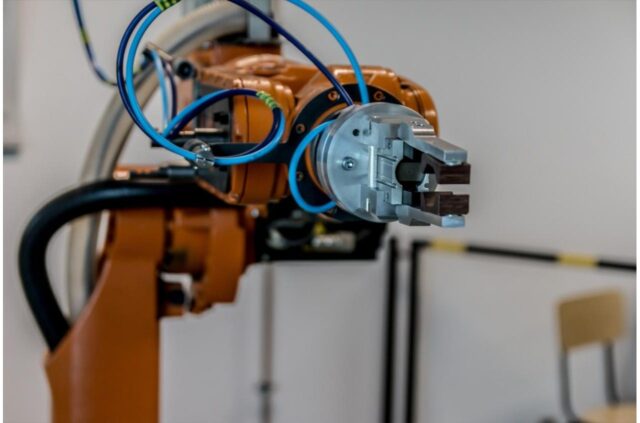
Robotics technology of today enables them to independently handle much more complex tasks and also gives them the ability to collaborate with both other robots and humans as cobots. In fact, the latest generation of robots has already proved itself to be a reliable and essential part of workflows in industries like EVs and advanced battery production.
Autonomous mobile robots and automated guided vehicles are also now revolutionizing how logistics are handled in these smart factories. These new autonomous logistics provide just-in-time delivery of materials needed in production lines and are also observed to significantly reduce work-in-progress inventory. The result is improved floor space utilization, which is a much-needed feature for scaling operations in the high-yield and autonomous manufacturing landscape of 2026.
These robots not only take the human workload but are also extremely good at delivering accuracy, speed, and tireless labor, which is something all industries desire. They have also made operations safer, especially in production routines where tasks are dangerous for human workers, including working with corrosive materials, high temperatures, tasks with high repetition, etc.
2.2. Industrial IoT Connectivity
This new innovative network of sensors is the backbone of automated factory automation technology in the modern manufacturing industry. In a simple sense, the Internet of Things, or IoT, is designed to give super connectivity to a factory. It works by sensing and transmitting data back from “smart machines” to AI-powered dashboards and control systems, and all of that happens in real time, which enables businesses to achieve crucial objectives.
First, they use this data to adapt & change their operations into a more streamlined process, both externally and internally. Moreover, these sensors also reduce downtime using predictive systems for failure detection and enable better traceability and energy optimization goals.
Other functions like asset tracking, improved field service, facility management, and enhanced customer satisfaction are the top touted benefits of IIoT and are already showing results in 2026. And most importantly, these functions enable factories to operate with faster response times and bring with them improved agility for operations of every size.
2.3 AI and Machine Learning in Factory Automation
In the heart of all the industrial innovations we mentioned here, AI and machine learning act as their central components. These are really the brains of modern factory automation technology and work by analyzing tremendous amounts of factory data from IoT, cameras, and on-field equipment to identify patterns in this data, predict failures in workflows, optimize related parameters, & make decisions to fix them in milliseconds.
Advanced machine learning algorithms are used to analyze available data coming from the factory floor. This includes sensor data, operational logs, & previous historical maintenance records. All this is fed to algorithms that use it to predict equipment failures well before they occur.
This monitoring enables predictive maintenance to be performed and significantly helps minimize unnecessary maintenance activities, which were a norm in classic working models.
These algorithms also help optimize factory operations by changing different parameters to tweak quality indicators, throughput, material utilization, equipment wear, energy efficiency, etc. This is now frequently done by factories to find optimal trade-offs that the previous generation of factory working models would struggle to identify.
These systems still require human intervention at management, but in 2026, we are seeing even more autonomous systems called “agentic AI,” which are designed to perceive their environment, reason about the set goals, take autonomous actions & also learn from outcomes, all without human intervention.
2.4 Digital Twins and Virtual Factory Simulation
These innovations are the true management marvels of the latest industry standard, as both have transformed how manufacturers design, optimize, & operate their factories. A digital twin is literally an exact virtual and digital model of a process, complete system, physical asset, material flows, and personnel in the field that is continuously updated with real-time data from its physical counterpart. In other words, a twin in the digital world.
Such a model is created to use it for planning, optimization, monitoring, & predicting outcomes. Before a new system or working routine is introduced, managers use this model to test various scenarios, identify bottlenecks in new models, optimize layouts to remove these bottlenecks, and validate changes before implementing them in the physical factory.
And all this is done in the digital world well before it is done in the physical world. This reduces the associated risk, cost & time associated with any changes in factory design, expansion plans, and optimization routines and also doesn’t alter normal factory operations already in place with virtual commissioning.
This results in a reduction of commissioning time by 30 to 50 percent, as observed in recent studies. To implement this digital twin, modern factories use comprehensive sensor coverage (discussed above) and high-speed connectivity systems; together, they feed the real-time data to keep the digital twin synchronized with the physical factory.
2.5 Additive Manufacturing and 3D Printing Integration
Another innovation recorded this year is the norm of using 3D printing in larger-scale operations, which was once only regarded as a prototyping tool. A new generation of 3D printers is used for “rapid prototyping,” with speeds of printing rates exceeding 100 cubic centimeters per hour and accuracy reaching sub-100-micron layer heights and dimensional tolerances exceeding ±0.1 mm!
This rapid and accurate printing allows engineers to create and test super lightweight lattice structures, integrated assemblies, and complex geometries in internal channels. These prototypes are usually also quickly tweaked to consolidate multiple parts into single components.
The coupling of industrial 3D printing with automation technologies of today is impacting in various ways; product lifecycle management systems can now quickly track prototype versions in the system and can design/filter out the prototypes to recent design requirements coming right from the CAD software of design engineers, removing the usual delay associated with traditional designing procedures. Similarly, ERP systems work better with 3D printing systems to monitor material inventory and cost tracking for any new prototyping operations in line. This not only makes it cheaper to make prototypes but also cuts down prototype lead times and product development cycles by more than 50 percent.
Speaking of cheap, 3D industrial printing also helps in cutting down costs related to maintaining physical inventory management, which used to also require maintaining large inventories across multiple locations & dealing with obsolescence of different equipment in use. This is done with the help of on-demand spare parts production, which essentially replaces physical inventories with digital inventories of equipment and their related parts.
2.6 Automated Quality Control and Testing Systems
AI-powered factories increase efficiency and speed of production, but for high-value products, demand for QC also becomes higher, which is met with advanced automatic test equipment of several kinds. All of them are designed to cater to modern electronics production, which works on complex electronic devices at the speeds and accuracies of AI-enabled high-yield factories.
These systems use multiple subsystems like precision power supplies, device handlers, and advanced signal generators to check the devices under test and seamlessly integrate their output data with MES & ERP systems for comprehensive quality management and complete traceability in manufacturing lines.
Other innovative tech in the testing landscape is battery aging and burn-in testing automation, which has received a lot of attention in the recent green energy and anti-fossil drives in different regions. These systems are designed to monitor the production processes, enable them with high throughput in each production cycle, and also bring data-rich testing to an end that ensures every battery coming out meets the set specifications while dramatically reducing testing time and production cost.
Most of these testing methods are employed in real life as inline and integrated testing platforms with production lines. These platforms work by monitoring and testing every single product as it moves through the manufacturing process. This scheme provides immediate feedback on any deviation related to these materials and enables real-time process adjustments for the management.

3. Successful Automated QC with Jettest
As the world moves towards supercharged AI-powered factories and integrated automated testing equipment, accuracy and high yield become the norm—industrial objectives not to be compromised. JETTEST exemplifies such objectives and how they are achieved with modern automation technology with its latest product offerings.
For example, their final ATP line for energy storage packs is held in the industry to carry out cutting-edge battery aging and burn-in testing automation routines with extreme accuracy. These ATP lines are designed to ensure every energy storage product being produced delivers claimed stability, durability, and safety in real life before reaching customers.
In the recent new energy innovations in the global industrial landscape, the photovoltaic power supply test system from JETTEST is receiving special attention for achieving 99.9%+ defect detection rates, which helps manufacturers achieve almost zero-defect manufacturing goals while also reducing testing costs by 50 to 70 percent as compared to traditional human systems.
4. Wrapping Up
This year, we are witnessing a revolutionary upgrade in the factory automation technology landscape, which is pushing manufacturing to a zero-defect, 24/7 autonomous, and real-time optimized operation. With such high yield and efficient systems, ATE is more important than ever and complements such autonomous factories, especially in high-value industries like battery production, electronics, etc. Looking ahead, the future of robotics and integrated ATEs is looking even more promising.