
1. Introduction
Almost all of modern power transmission is done on direct current, or DC. But its use is also common in modern solar and energy storage systems. Considering how important DC has become for the modern infrastructure landscape, the trending question of ” what is high voltage DC?” makes sense, especially with the rise of new energy solutions, long-distance bulk power transmission, offshore wind farm grid connections, etc.
The gradual global push towards higher-capacity utility-scale installations has also made DC more mainstream, but the demand for such systems running on high voltages means more risk associated with them. To mitigate risks, manufacturers need to allocate more resources to supplement testing, measurement, and safety procedures, especially for PV systems, which are gaining a lot of attention these days.
This guide explains the basics of high-voltage DC, where it is used, its applications in the solar industry, switching methods, and how it is changing with the arrival of AI systems and interconnected workflows of manufacturing facilities.
2. What is High Voltage DC?
As is quite obvious from the term itself, this form of DC has much higher values of voltage as compared to what we are used to using in consumer electronics or low-voltage control circuits. It is used to avoid transmission losses, which AC power is prone to over long distances.
In power generation and transmission networks, this high-voltage current is produced from AC sources, typically at an AC converter station, and is received by a DC converter station at the other end through transmission lines. Technologies involving line-commutated converters and voltage-source converters are used, which allow this DC power to travel longer distances and also connect to weaker grids & renewable sources.
The “high” voltages of DC can be a few hundred volts in local consumer electronics (like solar PV systems) and can reach a staggering 100 kV to 800 kV in transmission lines, with some advanced systems even having more than 1,100 kV!
3. How to measure High Voltage DC?
For commercial solar inverters in the utility sector, high-voltage differential probes or dedicated DC voltage sensors are required to measure HVDC without posing safety hazards and introducing significant error. Such equipment is designed to isolate and remove the operator from the circuit entirely and also step down voltage levels in a much safer and less lethal range.
These devices use Hall-effect current (shunt) sensors, which are basically designed to deal with saturation issues when measuring DC levels. These sensors also provide isolation and measure the magnetic field around the conductor carrying HVDC, enabling measurement without physically interfering with the high-voltage potential, but they are not highly accurate.
For more accuracy, closed-loop compensated versions of these sensors are used, which are designed to offer higher levels of accuracy. Such testing equipment is typically used on production test lines as manufacturers look for any measurement drift in external factors like rising or dropping temperature.
In modern production environments where automated testing equipment is commonly in place, all this happens in an extremely isolated and automated environment without needing human interference. The data is also directly fed into MES & is obtained with varying load conditions rather than as a single static reading.
4. High Voltage in PV Systems
This high-voltage DC is also used for transmitting power from utility-scale solar farms and finds its application in solar factories as well. As manufacturing capacities are increasing with AI systems, plant sizes & battery capacities have also increased. This, in turn, has also pushed the voltage levels running through them.
Modern PV strings and storage racks are designed to operate at a common high voltage level of 1000V or 1500V DC when in a large-scale setup. Locally used small setups in homes with solar panels usually operate between 600V & 1000V DC. It is worth mentioning that this voltage range is much more lethal compared to the locally used low-voltage system.
In today’s inverter industry, high-voltage DC is used in several places: DC busbars, connections inside energy storage systems, the output of PV strings before they reach an inverter, and initial DC input stages designed in central and string inverters.
Here, higher voltage levels are used to reduce losses in the system and make it as efficient as possible. But with such high-voltage design choices, testing, measuring, and validating procedures of such voltage levels demand much more robust safety and special measuring procedures.
5. Core High Voltage DC Testing Methods
5.1 Hi-Pot Testing
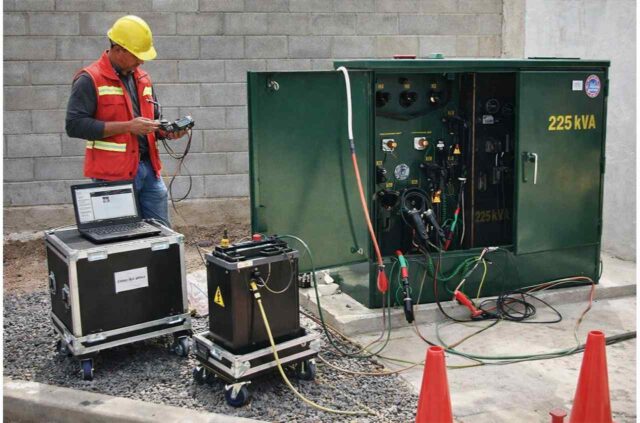
HVDC is not just for power delivery but is also extremely useful when it comes to testing modern energy storage and PV systems. Hi-pot testing is their most common application, which is used to check even the tiniest insulation degradation or manufacturer anomalies in solar systems (and for other equipment like power distribution panels, etc.).
To do this test, a high-voltage DC is applied to the insulation and ground during field commissioning. This is done to simulate a scenario of uncontrolled leakage of current. The equipment is checked to see whether it can handle transient surges without breaking down.
5.2 Ground Fault Detection
Ground fault testing typically involves monitoring for current imbalance between the positive and negative DC conductors. This is done with automated systems designed to flag & quickly isolate/disconnect a fault source before it escalates. In solar systems, this detection is continuously done, where protective systems are designed to flag a developing fault long before it grows exponentially into another safety hazard.
Modern monitoring equipment typically logs fault trends over time as well, giving O&M teams visibility into whether a specific string or section of the array is showing early signs of insulation wear well before it reaches a level that trips a full disconnect.
5.3 Accuracy tests for Voltage and Current
At high voltage values of DC, even the slightest variations in voltage levels pose a big drift in operating numbers of PV systems. Accuracy tests are designed to check this drifting and are an important routine in commissioning and compliance reporting.
The process typically involves comparing a device’s voltage and current readings against a certified reference standard across a range of operating conditions, rather than at a single fixed point, since sensor accuracy can vary depending on load, temperature, and where in the voltage range the measurement is taken.
5.4 Arc Fault Behavior Testing
Unlike AC, DC, when in arc faults, doesn’t come down to its mean value, which makes it extremely hard to extinguish in the fault scenario. Current inverter and PV system technologies are designed with protective criteria that can clear an arcing condition. Getting this detection right is a balancing act: a system that’s too sensitive will trip on harmless electrical noise, while one that’s not sensitive enough risks missing a genuine arc fault.
During this testing, controlled arcs under test conditions are maintained across the inverter, and its performance is recorded against the functions of how quickly it detects the arc faults and takes measures to clear this condition. Running this test under a range of simulated fault conditions, rather than a single scenario, also helps confirm the protection system performs consistently regardless of where along the string or circuit the arc originates.
6. HV testing with AI systems in 2026
6.1 Predictive Fault Detection
Advanced AI models are now being trained on historical test data maintained by PV system manufacturers. This helps the models to quickly and accurately flag early signs of insulation degradation or arc risk before a hard failure occurs, rather than relying solely on threshold-based pass/fail checks
6.2 Automated Data Analysis at Scale
Modern ATEs, which are designed to tie directly into the MES/automated testing. Such an arrangement enables AI to process the resulting data through batch comparisons and drift detection across production runs, perform more accurate checks, and deliver fault-free products.
6.3 AI-Assisted Compliance and Reporting
AI now enables managers to handle faster, more consistent documentation for commissioning and audit trails, reducing manual review time. This matters even more as HVDC deployments scale, as dozens of test lines across multiple factory locations benefit from having compliance data centralized and formatted identically.
7. Jettest’s High-Voltage DC Testing Equipment
Advanced testing equipment is already available in today’s market, which can easily automatically handle the above testing routines and also help manufacturers produce at scale. But Industry 4.0/5.0 transformation demands much more than better results; it needs whole-line data traceability & high compatibility with MES protocols of today.
This is what you can expect from Jettest’s photovoltaic power supply test system, state-of-the-art automated testing equipment designed to validate performance and reliability with industrial standards, & also run check protocols at the same voltage levels covered throughout the above discussion in this article.
This capable testing equipment runs the abovementioned testing protocols in one automated and fully connected sequence rather than as a separate workflow. Moreover, its modular design also means manufacturers aren’t locked into a fixed configuration.
This also means that test sequences & station layouts can be adjusted as product lines evolve, without needing to replace the underlying hardware each time a new inverter or battery pack revision goes into production.
For industries allocating resources for designing, manufacturing, or maintaining modern solar & energy storage systems, this ATE is an easy recommendation for maximum success when dealing with solar systems running with HVDC.
8. Wrapping Up
In our take on the rather common but fundamental question of “what is high voltage DC, we can conclude that it is not just a means to transmit power but is a core consideration for anyone designing, manufacturing, or maintaining modern solar & energy storage systems. There are dedicated procedures designed to test such systems working with HVDC levels.