
APPLICATIONS / ELECTRONIC COMPONENTS
Electronic Component and PCBA Testing Solutions
JETTEST provides automatic film capacitor test lines and PCBA ICT/FCT systems for electronics manufacturing. Select equipment around the device you produce, the electrical checks it requires and the way it moves through your production process.
Explore component-level testing for film capacitors or board-level testing for assembled PCBAs. Each project starts with your test specification, product connections and handling requirements.
What Defines the Right Test Configuration
Start with the device
A film capacitor and an assembled circuit board require different test connections and sequences. Identify the product family before selecting the station, fixture or handling arrangement.
Match access to the test plan
Provide terminal drawings for capacitors and board drawings with accessible test points for PCBAs. Fixture access, connection repeatability and product variation need to be reviewed alongside the electrical checks.
Plan the complete station cycle
The production cycle includes connecting the product, performing the tests and removing or sorting it. Share the target cycle time and changeover requirements so the station arrangement can be reviewed as a whole.
Choose Between Component Testing and Board Testing
If you manufacture individual film capacitors, begin with the electrical test line and its terminal connections. If you manufacture populated circuit boards, begin with the ICT/FCT platform and fixture access. This distinction helps focus your inquiry on the right equipment from the outset.
Film Capacitor Production Testing
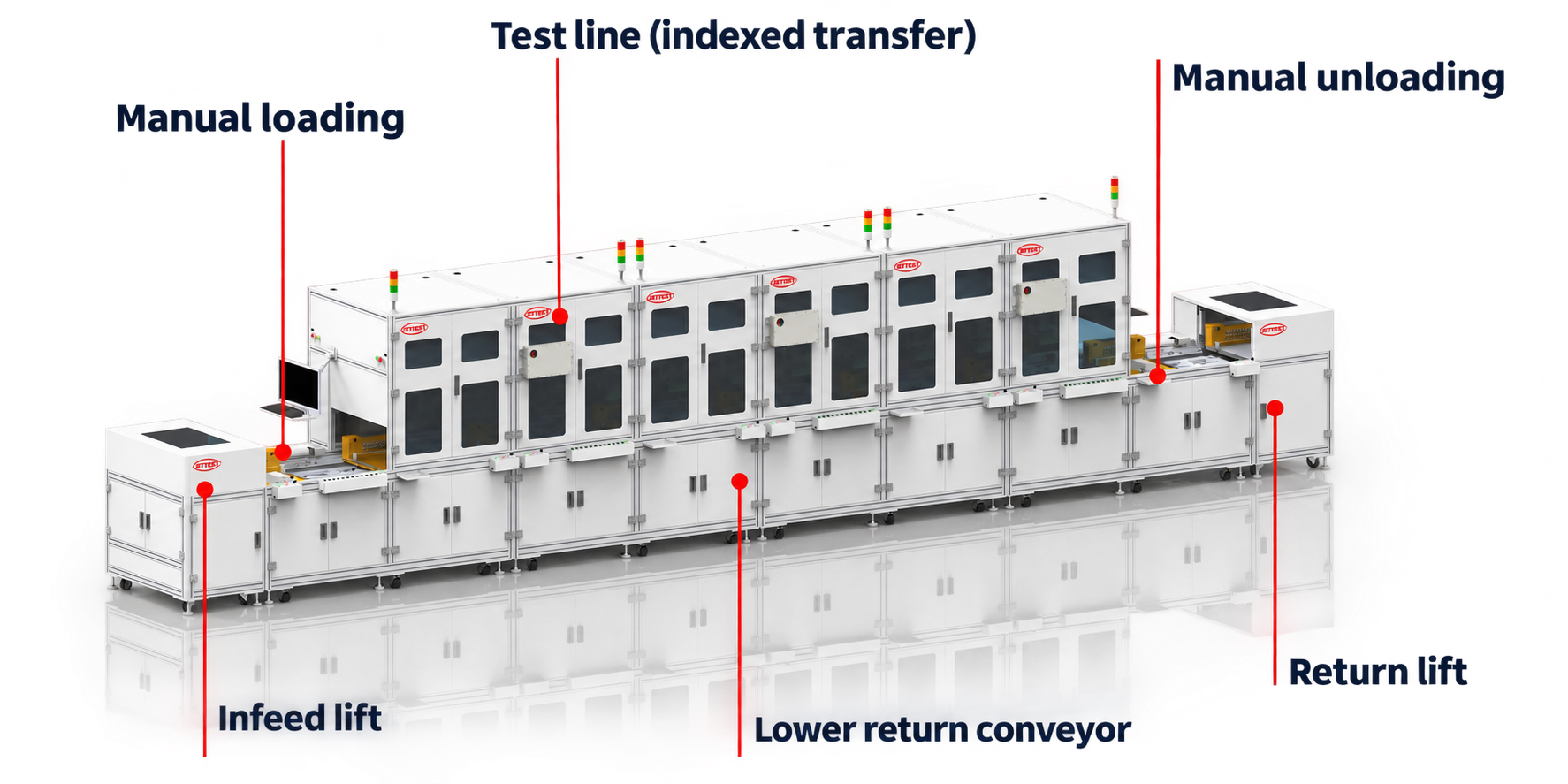
The film capacitor line includes electrical test stages for withstand voltage, insulation resistance, capacitance and loss. The process combines product transfer with manual loading and sorting operations. Confirm the required tests and handling arrangement for the capacitor family.
Applications include DC-link film capacitors for automotive power electronics, photovoltaic inverters, energy storage converters and industrial drives. Each capacitor family requires its own test settings and fixture review.
PCBA In-Circuit and Functional Testing
The ICT/FCT system combines board testing in dual or multiple stations. Its upper and lower split fixtures and board-edge positioning with tapered pins provide concrete starting points for fixture review. Compatibility with an existing ICT fixture requires assessment of the carrier-board adaptation.
PCBA projects can involve power supply, automotive, storage or industrial boards. Review each board layout, powered function and fixture requirement before selecting the configuration.
Compare the Test Configuration
| Selection point | Film capacitor line | PCBA ICT/FCT system |
|---|---|---|
| Test object | Individual film capacitor | Assembled circuit board |
| Electrical focus | Withstand voltage, insulation resistance, capacitance and loss | In-circuit checks and powered functions |
| Fixture review | Terminals, dimensions and carrier | Board outline, test points, split fixtures and tapered-pin positioning |
| Automation review | Transfer, manual loading, sorting and fixture return | Dual or multiple ICT/FCT stations and production integration |
| Acceptance inputs | Test voltage, duration, frequency and limits as applicable | Test sequence, operating points and pass/fail limits |
| Next step | Discuss film capacitor test requirements | Review PCBA specifications and fixture options |
A test list does not define measurement range or accuracy. Confirm both with the selected instruments and equipment configuration.
Functional Tests for Power Supply PCBAs
For power supply boards, the configured FCT sequence can address ripple voltage, inrush current, line regulation and power supply efficiency. Overvoltage protection and short circuit protection checks require agreed operating conditions and suitable electronic test instruments. The selected instruments, fixture and program determine the implemented test coverage.
PCB Test Fixtures and Design for Testability
A PCB test fixture must reach the required test points while locating and supporting the board. Include test-point access in your design for testability review, especially when different PCBAs will share a platform. Review the fixture interface and carrier adaptation before assuming that an existing fixture can be reused.
Test Stages and Project Configuration
Film Capacitor Test Process
01 →
Manual loading
Place the product on its fixture.
02 →
Identification
Scan the product barcode.
03 →
Electrical tests
Run the specified withstand, insulation, capacitance and loss checks.
04
Sorting and unloading
Separate and unload products with the specified manual operations.
Fixture return brings carriers back to the loading end. This is a stage overview; the detailed station order and selected checks follow the approved product-specific process.
PCBA Station Configuration Workflow
01 →
Define the board
Dimensions, interfaces and accessible test points.
02 →
Specify the tests
ICT/FCT checks and acceptance limits.
03 →
Match the fixtures
Instruments, fixtures and station count.
04
Review integration
Handling, result records and production interfaces.
This describes project planning, not a universal machine handling cycle.
Explore Related JETTEST Equipment
Automatic Film Capacitor Test Line
For film capacitor manufacturers requiring electrical test stages within a production transfer process. Review withstand voltage, insulation resistance, capacitance and loss requirements together with terminal access, sorting and fixture return.
Fully Automatic PCBA ICT/FCT Test System
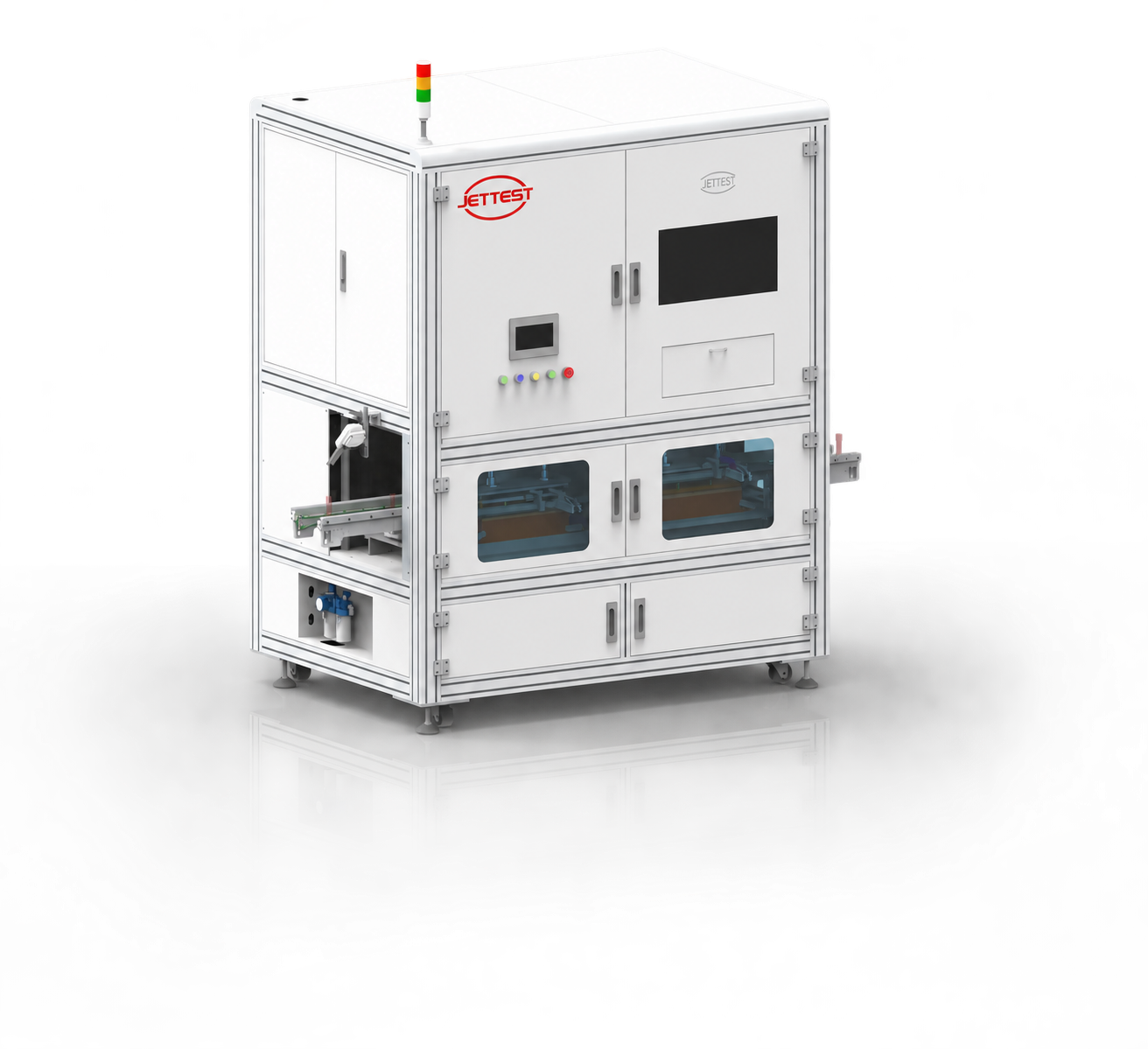
For manufacturers configuring automated board-level testing. The published equipment dimensions are 2000 × 1000 × 2000 mm and equipment power is 3 kW. These describe the machine, not the DUT test-power capacity. Confirm available space, utilities and fixtures for the proposed configuration.
Define Your Component or PCBA Test Station
| Send this information | What it helps define |
|---|---|
| Product drawings and connections | Fixture, terminal access and product positioning |
| Test conditions and acceptance limits | Measurement instruments and test program |
| Output target and changeover needs | Station arrangement and handling |
| Identification and result records | Barcode, record content and interface requirements |
What to Include in a Test Specification
For capacitors, state the required capacitance and loss limits, insulation conditions and withstand test settings. For PCBAs, list powered operating points, expected outputs and protection checks. Include the applicable test method and pass/fail criteria so the equipment discussion can move beyond a generic test list.
Equipment Matched to the Test Object
Choose a dedicated film capacitor line or a PCBA ICT/FCT platform. This keeps the equipment discussion connected to the product rather than applying one generic test process to every device.
Fixtures and Production Integration
Modular equipment and configurable PCBA stations provide a basis for reviewing integration with surrounding operations. Review loading, access, changeover and result handling before finalizing the project.
Review the Station Before Acceptance
Agree the samples, test sequence, result fields and handling operations used during acceptance. Review repeatability, fixture changeover and the approved cycle with the actual product. These are project review items, not a claim that every standard configuration includes the same functions.
Automated Testing Equipment in Production Quality Control
Automation in quality control starts with a defined test plan. State the measurements, limits and records needed for each product, then review how the equipment performs and records that sequence. This supports a consistent quality control process in manufacturing without turning a test station into a guarantee that every possible defect will be detected.
Questions About Component and PCBA Testing
Which system should I choose for film capacitors?
Start with the film capacitor test line. Supply the capacitor type, drawings and required electrical checks so the test stages and handling arrangement can be evaluated.
Can the PCBA system use different fixtures?
The system is designed for multiple fixtures and PCBAs. Existing fixtures still require a compatibility review, including carrier adaptation, positioning and access to the necessary test points.
Does ICT replace functional testing?
ICT and FCT address different checks. Review the component and connection checks alongside the functions that must be exercised with the board powered; the agreed test plan defines the coverage.
Are all loading and sorting operations automatic?
No single handling arrangement applies to every product. The film capacitor process includes manual operations. Confirm the manual and automated steps for the proposed line.
Can I specify a guaranteed production rate from the equipment name?
No. Provide the board or component, test sequence, handling time and changeover needs. The project capacity must be agreed for that configuration.
What is ATE and how does it apply to PCBAs?
ATE means automated test equipment. For this application, the PCBA ICT/FCT system combines configured instruments, fixtures and software to execute an agreed board test sequence. Review the equipment detail page to assess its station, fixture and functional-test options. Review PCBA automated test equipment.
Discuss Your Component or PCBA Testing Requirements
Send your product drawings, required tests, acceptance limits and production target. JETTEST can review the equipment, fixture arrangement and integration requirements for your project.
For finished power-supply loading and burn-in, explore Power Supplies. For automotive module testing and burn-in, explore Automotive Electronics.