
APPLICATIONS / BATTERY
Energy Storage Battery Pack Testing & Assembly
Household energy storage PACK assembly and final-stage testing, burn-in transfer and packaging equipment.

Household Energy Storage PACK Assembly Line
Choose Equipment for Your Production Stage
Start with the production stage you need to build. The household PACK assembly line processes cells into modules. The final ATP line covers downstream assembly, testing and packing. These are two distinct equipment options for energy storage manufacturing.
Cell-to-module assembly
Select the household energy storage PACK assembly line for cell preparation, stacking, joining and post-weld inspection.
Final PACK production
Select the final ATP line for downstream assembly, ATE around burn-in, cart transfer and packaging.
Testing & Production Capabilities
Cell preparation & assembly
The household line includes cell loading and sorting, polarity inspection and adjustment, taping and scanning, stacking and pre-compression, and module compression with steel strapping.
Cleaning, welding & inspection
The assembly process lists terminal laser cleaning, laser welding and inspection after welding. These stages are tied to the household PACK assembly configuration.
Final testing & handling
The final ATP line includes pre- and post-burn-in ATE, AGV movement of burn-in carts, buffers for nonconforming products, cleaning, bagging, carton insertion and palletizing.
Final PACK Testing & Packaging Workflow
-
01 →
Assemble & test
Housing and cell loading, product transfer and pre-burn-in ATE testing.
-
02 →
Transfer & burn-in
AGV moves burn-in carts into the burn-in area and removes them afterwards.
-
03 →
Post-burn-in ATE
Unloading from burn-in, post-burn-in ATE and product line transfer.
-
04
Pack & palletize
Cleaning, bagging, carton insertion, pre-packaging inspection and palletizing.
NG paths: Buffers are provided after pre- and post-burn-in testing. Return path: Empty test boards and test fixtures return to the process.
Reference: Final ATP Line for Energy Storage Packs. Includes manual assembly/test operations and automated transfer. Cell-to-module assembly uses the separate household PACK line.
Explore Related JETTEST Equipment
Household Energy Storage PACK Assembly Line
Cell-to-module assembly equipment for household energy storage PACK production.
Cell sorting, polarity inspection, scanning, stacking, laser cleaning, welding and post-weld inspection.
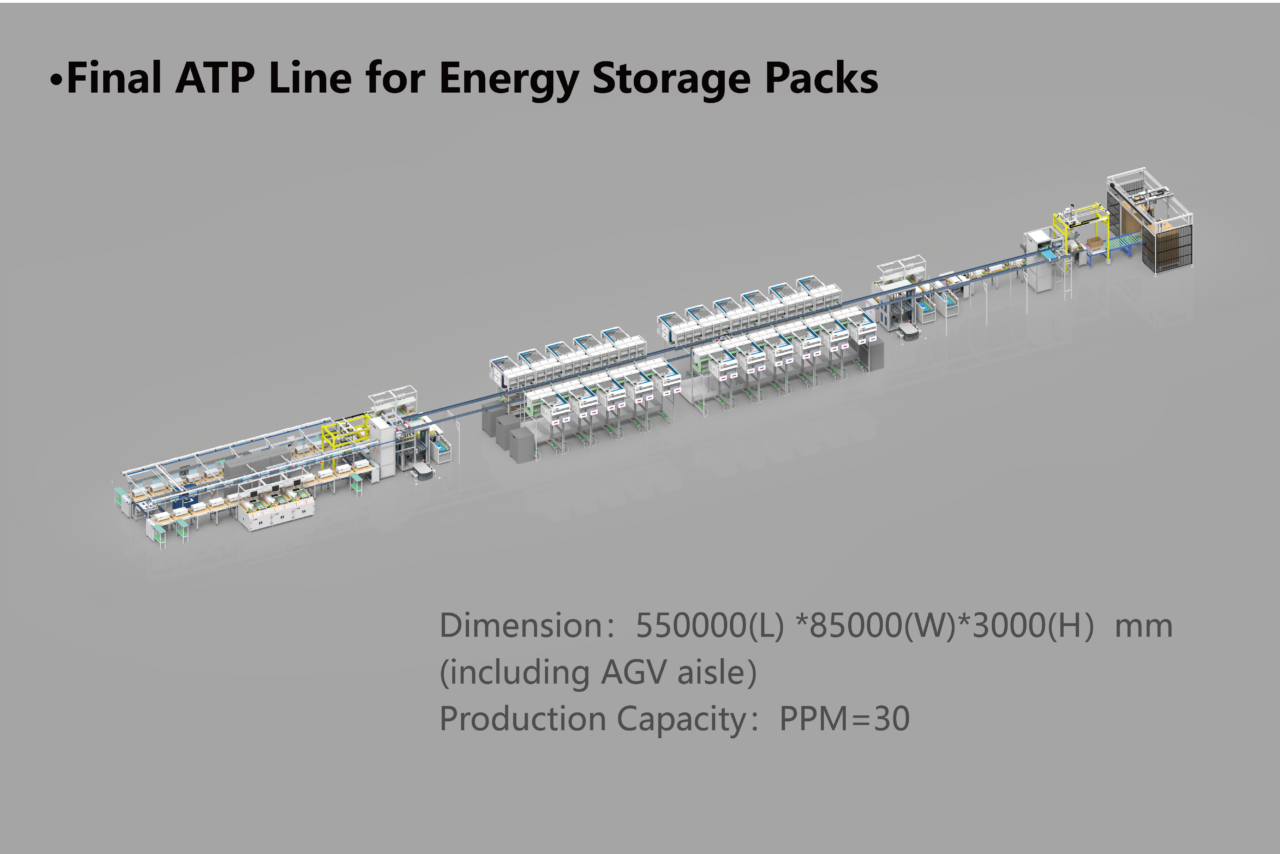
Final ATP Line for Energy Storage Packs
Assembly, testing and packaging operations for the final stage of energy storage PACK production.
Pre- and post-burn-in ATE, AGV transfer of burn-in carts, NG buffers, packing and palletizing.
Equipment functions, test conditions and handling arrangements are defined for the selected product and project configuration.
Define Your Equipment Configuration
Prepare the following information for a focused discussion with JETTEST.
- PACK design, cell/module dimensions and electrical ratings
- Required assembly and test sequence
- Burn-in duration, target output and operator tasks
- Available floor space, transfer routes and MES interfaces
Battery Questions
What is the difference between the two PACK lines?
The household assembly line covers cell preparation, stacking, laser cleaning, welding and inspection. The final ATP line covers downstream assembly, testing around burn-in, transfer and packaging.
Does the final ATP line include automatic transfer?
The documented line uses laser-guided AGV transport for burn-in carts, with product transfer equipment and buffers. Manual operations remain in the listed process.
What production data functions are documented?
Both PACK line descriptions specify process-data control, traceability support and MES protocol compatibility. The required protocol, identifiers and data fields should be defined for the project.
Discuss Your Battery Production Requirements
Share your product specifications, required process and production target so JETTEST can review the appropriate equipment configuration.