
1. Introduction
When doing a duel of manual vs automated testing, one can quickly deduce that both pose their benefits in different industrial settings. In fact, picking between the two has always been a binary choice, but in 2026, things have evolved to a more hybrid approach where human testers come in for intuition and automated (or AI-powered) systems are used for repeatability, accuracy, and scale.
Understanding both and comparing them still has significant practical implications for businesses that are planning for automated hardware in their plants. That is why global organizations are already reporting shifting QA priorities, with more than 62% of enterprises already accelerating test automation investments after 2022 (Gartner).
Most of the numbers coming out from this transition are positive, with case studies citing 20 to 40 percent reductions in test creation time and 30 to 60 percent fewer false-positive alerts. Below, we have deep-dived into the two, their scopes, pros/cons, and future roadmaps.
2. Manual vs automated testing in Theory
2.1 What is manual testing?
These tests are done by humans without automated inspection systems or test rigs. The entire process is based on human observation to test application behavior for defects. As restricted as it might seem, manual testing has unique strengths that stem from human cognition. Such testing can help in context-aware judgment, pattern recognition & the ability to pivot testing in real time based on observed behavior.
Today, manual testing has grown to exploratory testing, where manual testers simultaneously design & execute these tests. Common fields are usability testing, ad-hoc scenario exploration, accessibility checks, customer-focused acceptance, etc.
2.2 What is automated testing?
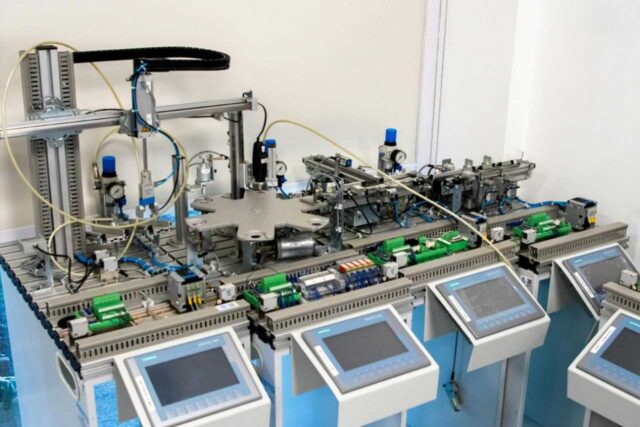
This testing framework uses advanced machines and testing rigs powered by software-controlled instruments and integrated inspection systems taking feed from sensors, all with minimal human intervention; hence, it is termed an automated testing scheme.
In today’s industry, such testing schemes have evolved into several forms; the most common ones are automated functional tests, end-of-line validation, burn-in systems, in-circuit testing, vision inspection, calibration checks, etc. Moreover, this testing scheme has become a core part of modern manufacturing lines due to ease of collecting structured quality data, reduced errors, and higher yields.
3. A Side-by-Side Comparison
3.1 Accuracy & Repeatability
Manual inspection still plays a role for nuanced failures: physical damage assessment, tactile checks, or complex mechanical fit/assembly issues often need human judgment. But for bulk verification, calibration, and parametric measurements, automation is superior.
Automated testing is crucial in industries where repeatability matters for compliance, and warranty reduction is needed for a production facility. Mainstream technologies like automated optical inspection are used for this objective, which works at speeds of hundreds of units per hour with micron-level precision.
Modern automated testers are now integrated into production lines, enabling high throughput (of at least 50 percent in most cases) with inline feedback. Because such throughput & repeatability are beyond human capabilities, manual visual inspection cannot achieve such speed, scalability, and accuracy.
3.2 Speed & Scalability
The prime objective of Industry 4.0 is not just speed but how well one can move through the line without losing quality, which is what automated testing delivers. This happens with speed and accuracy, which is extremely important during scalability drives for a manufacturing business.
For example, a factory that produces a certain product of multiple SKUs and customer-specific configurations will need a QA system that can quickly adapt to its varying products in its production lines. On the contrary, manual testing with human intervention does not scale efficiently when output grows. Traditional manufacturing, which hasn’t adapted to Industry 4.0 frameworks, might still survive with only manual frameworks of testing.
3.3 Risk & Compliance
Several industries are extremely demanding of risk management and compliance for their operations, like medical, power, and certain industrial electronic sectors. Automated testing frameworks are used here to take away the audit burden and risk of non-compliance that manual testing is known to inherit.
Automated testing routines provide necessary traceability in manufacturing and also quickly and accurately record calibrated test equipment, timestamped logs, and standardized test procedures that auditors expect. But in certain industries, a hybrid strategy is used, as human assessments are also required to perform visual conformity checks, labeling verifications & real-life ergonomic evaluations.
4. AI Disruption in Testing Routines
Classical automation in the industrial testing sector entered in the 1960s and 1970s but was limited to robotics & numerical control systems. In the 1980s, this evolved into “if-then” systems, but the real disruption happened in the 2010s when testing systems that could continuously inspect production in real time came along.
These testing systems were powered by machine learning, smart Industry 4.0 analytics, and vision systems. This happened with the rise of the Industrial Internet of Things and much more advanced AI models, which could be trained on the massive, real-time datasets collected from sensor networks.
The collected data is used to detect microscopic flaws and predict equipment failures before they occur in the field. The debate of manual vs automated testing is widely answered to be taking both in a hybrid mode, but the transformation of automation architecture in manufacturing facilities has significantly impacted three major industrial aspects of industrial testing where our manual skills are not relevant.
5.1 AI triage & Root-cause analysis
When a failure occurs on the manufacturing line, traditional triage with manual testing requires engineering teams to isolate faults by manually sifting through disparate data, while AI-driven triage transforms this debugging process into a real-time and diagnostic pipeline.
It does that with the help of advanced sensor logs, automated optical inspection, and parametric waveforms to instantly ingest multi-modal data right at the moment of a test failure. With this architecture, it determines whether this problem stems from a product defect, a localized environmental fluctuation, or a drift in test bench calibration itself.
This failure and its data, once flagged, are then quickly correlated with the immediate test data, where broader historical and upstream factory variables are compared, tracing back from where this all started. This automated tracing is precise and quick, which saves scraps and increases efficiency in testing routines.
5.2 Enhanced test generation & maintenance
The most significant change is reduced test-script maintenance and accelerated test-plan creation for a manufacturing facility where such systems will even add more parametric checks or tighter thresholds on areas where manufacturing lines have observed higher-than-average defects.
This happens due to the AI-powered system’s capability to analyze historical failure patterns and quickly correlate them with test parameters to suggest new test coverage areas.
Moreover, modern convolutional neural networks are now used, which can adapt to new defect modes discovered in production & avoid false alarms (as seen with heuristic-based AOI rules). This results in lower manual review effort for maintenance and much more efficient automated testing.
5.3 Smarter test selection & prioritization
The latest generation of automated testing runs with predictive test selection, which uses a parent-child, top-down hierarchy (BOM relationships) that defines how a finished product is built. This enables the system to predict & prioritize which products or lots need the most intensive testing.
Moreover, modern automated systems are designed to maximize throughput while minimizing wait times when carrying out these tests by using smart scheduling optimization.
This entire smart selection and optimization of automated test equipment also needs maintenance to constantly perform. For this, AI models trained on equipment telemetry can quickly forecast failures of test benches, handlers, environmental chambers, etc.

7. Adopting a Unified Testing Strategy
All the mainstream industries of today, including manufacturing facilities of power, solar, electronics production, and smart devices, don’t take manual vs automated testing frameworks as rival camps but build a testing strategy with the goal of less scrap, shorter yield cycles, and higher yields. In essence, AI is bridging the gap between and now uses both of them in harmony for Industry 4.0 frameworks.
In other words, manufacturing facilities combine manual testing, automated testing, and AI-assisted analysis to achieve their high efficiency goals. Engineers devise the right combination of hardware test automation, AI-driven prioritization, and selective manual verification with human intuition in the end, which typically follows these steps:
7.1 Starting with the highest-value test layers
Engineers divide the manufacturing process and products into layers and identify the ones that have the most value or repeatability, as such layers require tests that are usually the most expensive ones. These layers often require traceability as they create downstream warranty exposure if missed.
A practical roadmap is to automate first such layers, as this is where repeatability with automation matters most. Once these are picked, then layer manual inspection on top of them only if human judgment truly adds value. This layer can be used to point out visual defects, unusual failure modes, assembly nuances, or acceptance testing.
7.2 Build a hybrid workflow around data
Once engineers are sure of the layers in their manufacturing facility, the next step is to connect test data into one quality loop so that they can not just see pass or fail results but also see patterns across time, product family, suppliers, lots, different shifts & equipment cells. For this, they connect test stands, QMS, MES, SPC, defect images, calibration records, failure logs, and dashboards, all in one loop.
This workflow, built around actual data, makes the testing infrastructure a real powerhouse, especially in industries like solar and electronics plants. AI-powered vision systems are used to inspect defects at high speeds, while AI flags the tiniest solder issues, output drift, and human or module defects. Once flagged, engineers are brought in to validate the root cause of such an anomaly and adjust the process.
7.3 Standardize & train
Once workflows are built with specified layers, the next step is to standardize how it’s going to be operated. This ranges from a standardized single naming convention for tests to one rule for calibration and traceability of errors, one policy for data retention, a single set of rules for individual testing, etc. In essence, automated and manual testing demand an organizational change rather than just a technology shift.
8. Common Pitfalls in Industrial QA
- Over-automation &brittle testsare the most common pitfalls for first automation drives. This leads to fragile test benches, complex scripts, very strict thresholds, etc. The best approach is to automate only the layers that are repetitive, high-value, and measurable.
- Poor connection of QA data andproduction dataresults in failing to go through yield loss or recurring defects, which are usually linked to supplier batches, shift logs, and failure reports. Integrating QA outputs with QMS, analytics dashboards, and MES itself fixes this.
- One of the most common reasons behind expense reworks is observed to be scaling automation too quickly without a pilot. To avoid that, always start with one high-value linein a manufacturing facility and prove the desired ROI. Once achieved, proceed to scale in phases.
- As scaling is now a new norm in automated manufacturing, during this, not updating tests as products evolve is quite common. Test logic needs regular updates to fit with scaling or changed suppliers/raw materials.
- Another common mistake is implementingAI testing systems without enough domain data,which easily leads to misleading results. To avoid this, a better practice is to focus on use cases where the domain data is much stronger, along with obvious business value.
9. Get Automated Confidence with Jettest
The real objective of an automated system should not be limited to just speed but to confidence in operations and repeatability in results. For this, companies are seeking an integrated system in their automated testing routines that can reduce manual handling while improving consistency.
An example of such systems is the Automatic PTC Heater Test Burn-In Line from JETTEST, which is designed to exactly do this job. Its advanced new design and state-of-the-art internals enable factories to improve product reliability, reduce warranty risk & keep defective units from moving downstream.
You also get better documentation of tests, which is extremely useful for internal quality reviews and audit readiness. JETTEST offers several other similar indsutry leading testing platforms to compliment and enhance automated testing routines so that manufacturers can operate with faster, smarter, and more dependable quality systems.
10. Wrapping Up:
The classic comparison of manual vs automated testing is fading in 2026 because modern QA frameworks no longer fit into a simple either-or box. The practical way is to combine repeatable automation, AI-assisted insights, and selective manual validation.