

1. Introduction
As AI systems push efficiencies and throughput numbers in the EV and energy storage industries, related battery aging labs have also started to feel the mounting pressure. The testing industry is catching up with automated solutions that are equipped with much more advanced electronic test instruments that are designed to work faster and generate much more reliable data while handling higher voltages, stricter compliance requirements, and complex profiles related to battery aging.
The latest generation of instrument testing hardware is evolving into not just performing faster but also thinking better to adapt and perform automatically in a better way. For this, artificial intelligence is being deeply embedded into modern test instruments & their related control software. We are going to investigate here how AI has changed this automated segment of the modern battery industry & how manufacturers can prepare themselves for this new automated future.
2. Evolving Test Instruments in Battery Aging
The instrument industry for battery technology has been pretty much far away from passive methods, as in industry 4.0 and 5.0 standards, the requirements of accuracy, stability, and repeatability are not negotiable. In the past few years, the rise of the EV industry has made the chemistries, application profiles, and pack designs much more complex.
To match the production of EVs and their related battery systems, companies are now using testing equipment that doesn’t act as a measurement box but instead serves as an intelligent node, connecting with manufacturing lines in a connected test ecosystem. All these systems are responsible for common testing schemes such as calendar aging, accelerated life testing, and cycle aging, all performed with advanced test instruments while continuously logging data.
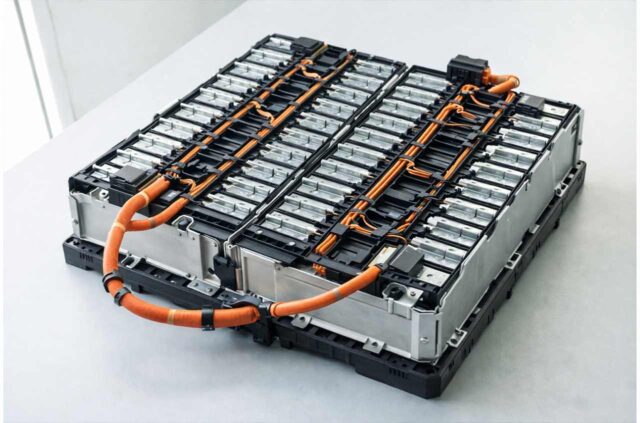
These instruments include a battery cycler/test system present in the battery test channel, a data acquisition system, an electrochemical impedance spectroscopy analyzer, an environmental/climate chamber, a reference electrode/three-electrode setup, a Coulomb counter/high-precision charger, etc. In 2026, several technologies have transformed these electronic test instruments and test benches.
3. Key AI Capabilities Transforming Battery Aging Workflows
3.1 Predictive Diagnostics
One of the most significant AI developments in the modern battery testing labs is its ability to commence predictive diagnostics. Engineers now don’t just look for hard failure or capacity fade in their testing routines but also use AI models to quickly analyze subtle patterns in measurement data to detect early signs of degradation, internal faults, or unsafe operating conditions.
For this, charge-transfer resistance, solid electrolyte interphase growth trends, and diffusion-related elements are monitored for their impedance response when they are applied with small AC perturbations over a range of frequencies. Prognosis models are run in the AI-enabled test software, which receives series data from these electronics to accurately learn patterns and detect several forms of failures.
3.2 Dynamic Load Control & Adaptive Test Profiles
With AI-enabled AI controllers on the instrumentation bench, a cycler built with modern electronics serves as an actuator rather than a fixed static testing profile. By getting feedback from this AI controller, it can adjust to real-time setpoint updates for a more dynamic testing process. Similarly, an environmental chamber also works in the same way as it can dynamically adjust temperature in a closed-loop adaptive stress testing environment.
This AI dynamic adjustment also works for DAQ readings like voltage, temperature, and current levels in the lab testing chamber. This creates a self optimizing testing ecosystem, where instrumentation not only records data but also actively influences the test process.
3.3 Automated Data Management
With fast and dynamically adjusted automated testing systems, modern ATE uses a software-layer integration downstream of every instrument, working attached to AI/ML pipelines. All the raw data coming from these instruments is fed into the central test-automation software/database, which automatically manages it.
This management includes functions like sensor-dropout imputation, outlier removal, unit normalization across instrument vendors, etc. The end result is that engineers can use the clean data for generating capacity-fade summaries of battery packs under testing, including other important measurements like resistance-growth charts & pass/fail statements.
3.4 Integration with LIMS, MES, and Cloud Analytics
Test automation software bridges the laboratory information management system and the manufacturing execution system via standard interfaces. This network is integrated with cloud analytics platforms, which are designed to ingest the incoming battery testing dataset for cross-cell & cross-batch trend analysis.
This AI-powered architecture not only enables the engine to compare aging results and battery behavior across each batch but also can track each data point and its origin using instrument-level identifiers, hence acting as a supervisory loop for modern EV factories.
3.5 Anomaly Detection and Real‑Time Alerting
Apart from the modern connectivity & dynamic adjustments for test profiles, AI systems supercharge electronic test instruments to generate much more precise and accurate anomaly detection passed to engineers through the test-automation dashboard/notification system.
For example, the anomaly-detection models, like autoencoder reconstruction error and isolation forest, run in parallel with the DAQ streams (data for temperature, current, and voltage) to monitor any anomaly, all in real time. Similarly, the equipment checks for any slipping thermal runaway precursors through gas analyzers, thermal cameras, and pressure transducers enabled with AI & ML algorithms that respond within milliseconds.
4. Avoiding Pitfalls in AI-Powered Testing
4.1 Choosing Right AI‑Enabled Electronic Test Instruments
While AI and its subsequent technologies have revolutionized testing benches in the modern automotive industry, they have also inherited failure modes never seen before. The most common is vendor lock in via proprietary AI features, which occurs when an OEM restricts compatibility, making it difficult to combine data across a lab with mixed equipment. Relying on simpler and more open systems is the way to go.
For this, engineers now prioritize open architecture test instruments designed with standard communication protocols such as OPC UA, MQTT, or Ethernet/IP. Moreover, algorithm transparency should be considered, as immature systems lacking explainable AI frameworks can actually harm results rather than improve testing routines.
4.2 Data Infrastructure, Security, & Interoperability
Fragmented data formats, interoperability with legacy LIMS/MES, and bandwidth and storage underestimation are the most common problems reported in recent years related to data infrastructure in AI-powered testing labs in the EV industry.
Reasons behind these issues are different formats of each testing equipment, underprovisioned storage/network bandwidth, Compromised test control channels, and older LIMS/MES platforms not designed for real-time streaming or ML-scale data volumes. Compliant middleware or API gateways, stronger security rigors, clear data isolation, and contractual protections fix these issues.
4.3 Training & Change Management
Automation does mean that knowledge & skills related to electrochemistry and instrument operations are no longer required in EV testing labs for the next generation of battery tech. Modern theories fix this by managing cross-training and enabling much more embedded “translator” roles.
Not all are skill-related issues; companies also need to have dedicated resources for model monitoring so that they can avoid under-resourced MLOps. Similarly, audit and compliance risks arise when there is not enough data explanation or skill available on-site to interpret why an AI system made a certain call during its testing, especially with new battery chemistries and workflows.
4.4 Over‑Automation & Black‑Box Decisions
As mentioned above, one of the most transformative advantages of AI systems powering electronic test instruments is the arrival of adaptive test profiles, but giving such systems full autonomy without human-in-the-loop safeguards is one of the most significant reasons leading to missing a real fault.
This can happen due to several reasons as well: An AI model misinterpreting a sensor fault or new chemistry and design optimization is misunderstood by the electrical test equipment in place. Overly sensitive models are also observed to create similar issues. Monitoring changes in battery signs and updating test algorithms are essential, along with deliberate training on manual analysis.
5. Jettest
This revolutionary new change in the instrument layer of battery aging labs for the EV industry is happening fast and for good. The industry and its testing equipment providers are also repositioning their product portfolio to fit into this new smart and interconnected AI-powered ecosystem. For modern testing labs, partnering with the reliable equipment-supply side is more important than ever.
This is where Jettest has positioned itself with its new automated PACK assembly and test systems, especially the Final ATP Line for Energy Storage Packs. This testing equipment is designed to mirror a cycler-plus-chamber combination as discussed above & gives manufacturers an autonomous and reliable single connected line where they get several core functions.
This includes battery module assembly, product endurance aging, and BMS communication verification, all in one highly compatible and integrable solution. It is built with programmable DC power supplies, high-precision electronic loads, and multi-protocol control, communication/acquisition cards. Such a capable system functions as a source/sink & data-acquisition building block when integrating AI-powered capabilities in testing routines.
Although dedicated EIS instruments required to process impedance spectroscopy & coulombic-efficiency data are not present here, it is still worth mentioning that Jettest systems are designed more towards testing pack- and module-level aging and automotive-electronics burn-in. But it serves as a solid integrable testing block when integrated with an EIS analyzer or high-precision coulometry unit.
6. Wrapping Up
Modern testing hardware with electronic test instruments works more like connected and adaptive systems, which not only catch anomalies within milliseconds but also process them for action while feeding their report data into MES, LIMS, & cloud analytics so that engineers can have plant-wide visibility and can make much quicker and better decisions towards battery R&D. The goal should be innovation and interoperability with reliable testing equipment in place.