
1. Introduction
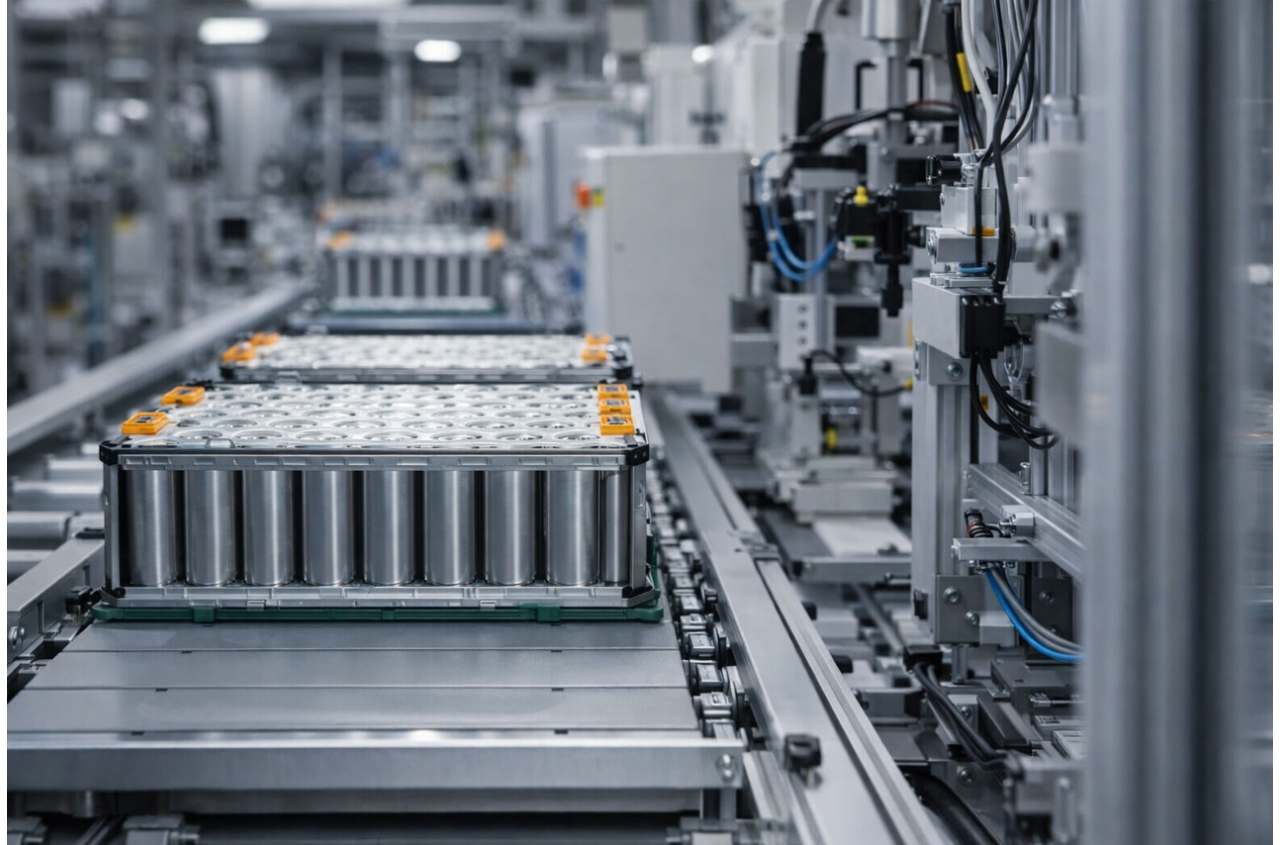
We are witnessing a tremendous push in R&D for advanced battery technologies across several industries. From automotive to renewable energy, all sectors are linked to battery tech & are increasingly investing to truly unlock the power of automation in their manufacturing facilities. The reason for this is the huge demand for reliable, high-performance batteries in the “electrified” automotive industry trend of 2026.
Another reason is that the sooner the companies are able to integrate automation into their facilities, the better positioned they will be to compete in the electric vehicle market, support large-scale grid-scale energy storage, or deliver portable power solutions for consumer electronics. This is bringing in huge pressure for the manufacturers this year to produce more, faster, and with higher-quality batteries than ever before.
But major challenges like skyrocketing production volume demands, complexity of new chemistries, sustainability, and decarbonization concerns are significant for manufacturers. Below, we have explored how automation is driving breakthroughs in battery technology throughout 2026 and beyond.
2. Automation & Battery Manufacturing
Battery production used to be quite manual and relied on classical industrial methods to manufacture them. Its production relied heavily on manual labor for cell placement, internal welding, wiring, & quality inspection. Use of semi-automated stations was common for handling delicate components under tight tolerances, which were still prone to errors.
This production style worked for small-scale production, but it quickly became unsustainable as demand grew in the past decade, especially with the EV boom. This year, we are now observing fully automated battery production lines with end-to-end robotic systems. Manual labor is gone, as these lines handle everything from electrode coating & drying to other activities that were once favored to keep manual, like cell stacking, welding, casing, and final testing.
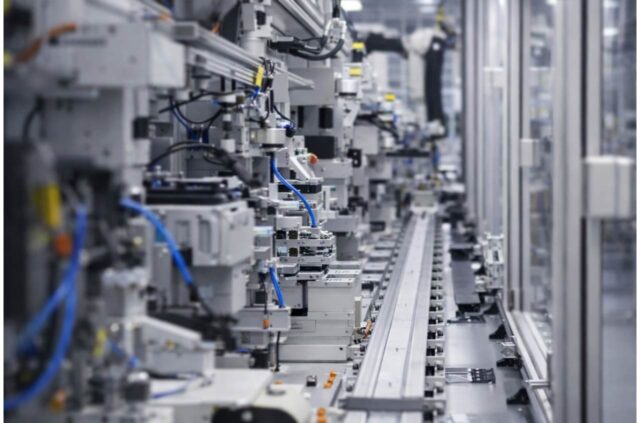
And what’s most impressive is that these lines keep on working nonstop with minimal human intervention. Battery manufacturers are achieving throughput rates of production that manual or semi-automated lines simply cannot compare with. These results are due to fully or semi-automated technologies that integrate web handling, advanced robotics, machine vision, precision motion control, & MES/SCADA systems to coordinate thousands of manufacturing steps per hour.
All this runs in a “closed-loop” control system fed by data from the Internet of Things. This manufacturing arrangement is what makes gigafactory-scale production in 2026 and has proven to be a stable mass-scale operation despite variations in raw materials and other external changes in the industrial landscape. Below are the five most prominent technologies where the true power of automation is locked in battery production.
3. Automated Tech in Battery Production
3.1. Roll-to-Roll Electrode Coating Systems
These automated systems work on production lines by using electrode coating feeds in the form of continuous metal foil from an unwinder through a coating head. A dry slurry powder in dry coating is applied as a controlled and ultra-thin layer on these foils, which are then passed through drying, where the solvent is removed, and the applied coating is compressed to the required density & thickness before being rewound.
Working in such a continuous loop allows tight control of surface uniformity, thickness, and porosity of the film. More adjustments are made for web speed, slot-die gap, coating pressure, nip forces in the calender, and drying profile to get even more accurate results. This is achieved by using advanced systems of inline gauges coupled with high-resolution cameras to detect possible defects like streaks, edge buildup, and pinholes, or they automatically correct or reject defective segments.
The coating results with these automated systems are highly efficient with uniform coating on the anode and cathode while maintaining the mechanical integrity and ion transport paths. This coating technology is also proven to directly improve the capacity, rate performance, and cycle life of batteries, a key demand for the new generation of EVs.
3.2. Robotic Cell Stacking
Stacking in battery production involves picking & placing electrode sheets and battery separators from cut‑to‑length web lines. This is specialized and extremely accurate stacking, which is done to create a precise stack to create a uniform stacked cell core.
An automated system of robots equipped with vacuum grippers, highly sensitive force sensors, and vision alignment is used in this process to ensure that each layer is positioned within accepted values of tolerances for overlap, offset, & orientation. They also integrate in-line measurement of stack thickness and flatness by following a programmed stacking sequence and reject stacks that fall outside specification before they move to the next station.
The results of such automated stacking meet safety standards due to highly consistent pressure distribution and electrode alignment inside each cell. This high throughput and automated yet precise production reduces internal short‑circuit risk, improves current density uniformity, and leads to tighter capacity distribution across various production lots.
3.3. Automated Electrolyte Filling
Fully automated stations preceding activities for electrolyte filling inside the battery. These are handling of cell evacuation, controlled dosing of liquid electrolyte inside the battery, and multiple fill-and-rest cycles, usually carried out in a dry room environment. To ensure deep penetration into the electrode stack, the battery cells are clamped and evacuated to remove air/moisture from the pores. Then, finally, it is filled under controlled pressure.
This entire automated process is monitored under tightly controlled working cycles, where weight measurements are often combined before and after filling to verify that the correct amount of electrolyte has been absorbed in the battery cell. Modern automated lines also add gentle vibrations in this production phase, along with temperature control, to improve battery wetting of thick or high‑energy electrodes.
The final results manufacturers get from this automated filling are consistent electrolyte saturation in the battery with very low impedance variation, improved low temperature, and minimal dry spots that can trigger lithium plating and local overheating.
3.4. Laser Welding & Sealing Systems
Both automated systems use highly focused laser beams, which are typically mounted on a high-precision robot or gantry and are coupled with vision systems to locate the weld features & track their position in real time. Such an automated arrangement is capable of commencing error-free welding of battery-critical components like current collector tabs, enclosure parts, and busbars.
Such systems ensure high precision and minimal thermal distortion while maintaining high throughput. This is achieved with the help of weld‑pool sensors, inline resistance, and acoustic emission to quickly deal with porosity, misalignment, and lack of fusion. To ensure reliable results with different materials, parameters like laser power, pulse duration, scan speed, and spot size are automatically fine-tuned to match the different metals and varying thicknesses being joined.
The manufacturing results of these systems are batteries that are built with robust electrical connections with very low contact resistance & hermetic seals that protect the cell from moisture/gas leakage, and all this is achieved with high repeatability, reduced rework, and scrap.
3.5. Automated Formation & Aging Tests
These systems are designed to carry out the first charge–discharge cycles of each cell in the battery. This is where the solid electrolyte interphase is formed & the newly produced battery cell’s early behavior is recorded and characterized. To perform this, cells are autonomously loaded into large racks or trays connected to multi-channel formation equipment, which can control different battery variables like current, voltage, temperature, and timing with high precision.
During these tests, the automated system executes optimized formation protocols and logs battery behavior in terms of voltage, current, temperature, and capacity data for each cell individually. These tests are done in integrated climate chambers that keep the inside temperature within predefined, tight limits.
The software running these tests quickly analyzes the data in real time and classifies cells according to their performance, detects early failures, & suggests adjustments. The final result is testing of stable solid electrolyte interphase layers with much improved cycle life & well-characterized cells.
4. What’s Next For Batteries?
4.1. Extended Reality for On-Site Training
PowerPoint training and hands-on practice in a safe room is now being quickly replaced by technologies like augmented reality, virtual reality, and mixed reality, which are used to train new personnel for the above explained manuafctueing process of batteries. For this, AR glasses or tablets are used to overlay step‑by‑step work instructions directly onto machines for fast learning access.
Similarly, XR systems are used to standardize training across sites, which significantly reduces onboarding time for new staff & also supports access to remote experts who can “see what the operator on the ground sees” and guide them from anywhere.
4.2. Virtual Commissioning
New systems now create a physics‑aware digital environment before any real hardware is turned on for battery production by using digital twins for the entire facility. These twins are also used by engineers to experiment with different buffer sizes, layout changes, and takt times during battery production workflows, all without stopping real production or risking scrap.
This also means that, for engineers, debugging edge cases becomes easier and safer to handle when commencing coating, stacking, electrolyte filling, & final formation is virtually done well before actual work begins. This also gives the management a shorter time to production by removing physical commission, smoother ramp-ups & significantly more confidence when rolling out large-scale automation upgrades.
4.3. Agentic AI Systems
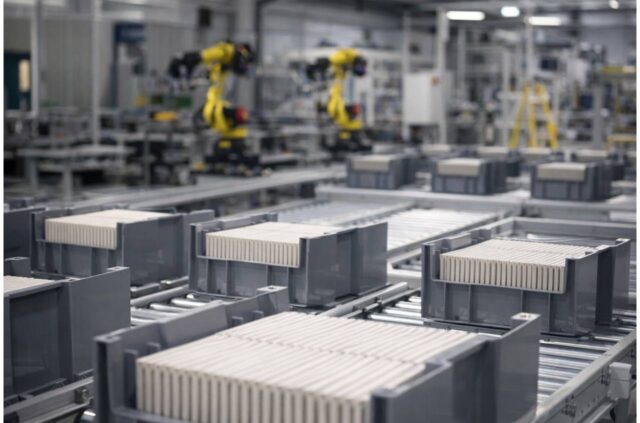
As the name suggests, this AI technology uses its “agents,” which are designed to do one job only in a manufacturing facility. For example, one agent focuses on battery quality by detecting the tiniest drift before scrap spikes on the other end and another on maintenance by predicting failures & scheduling interventions.
Think of these agents like connective tissue for the entire operation in which these systems close the loop between how cells are designed, how they’re constructed, & how they perform in real life. The result is an automated facility of battery production where these interconnected AI agents coordinate continuous improvement.
5. Challenges
5.1 Fragmented Systems/Data Quality
Battery production facilities that are not integrated with automated systems face a common issue of bad data quality and errors related to fragmented hardware on their manufacturing lines. Activities like battery coating lines, stacking robots, laser welders, formation racks, and test benches often run on different PLC systems, OEMs/vendors, and databases that don’t talk cleanly to each other.
This is a major problem, as AI is only as good as the data it sees; if the AI implemented in the manufacturing facility is learning from misaligned signals, its predictions and recommendations will be noisy and misaligned as well.
5.2 Unknown “Unknowns”
From the abovementioned battery production routine, you might have noticed that the entire process involves state-of-the-art engineering requiring tight coupling of electrochemistry, mechanics, thermal behavior & materials science. Latest battery technologies involving new chemistries like high‑silicon or high‑nickel designs can cause AI to picture correlations and relationships that are highly nonlinear and not fully understood by humans yet.
The implication of doing this is that an unknown in the manufacturing workflow of a battery with an AI agent might improve short‑term yield but may slowly damage long‑term cycle life in ways that were once unknown in the AI-powered dashboards and only show up months later in field data.
5.3 Slow Change Management
There are huge gaps in skills and knowledge when it comes to automated battery production in 2026. OT engineers are well-trained and know their production lines, but not the models behind them. Similarly, the data scientists know the models but not the realities of a dry room at 3 a.m.
To fix this, management has to conduct multiple elaborate training sessions, engage in cross‑functional teams, and create a culture in which AI-powered systems are a copilot and aid the operations with monitoring panels of engineers.
6. Automation Success with Jettest
Even with all the complexity & challenges (mentioned above) in modern battery production, some players of the industry are already delivering integrated systems that close the gap between implementation theory and reality with minimal implementation issues. JETTEST is one of those players that now offer the next generation of new energy vehicle test systems & automated battery pack assembly lines and enable manufacturers to work with testing and automation as a strategic capability.
These systems from JETTEST are destined to bring the crucial processes of battery coating, assembly, BMS verification & long-term aging all under one umbrella. For example, their automated PACK assembly lines are designed to combine high-speed assembly with reliable and industry-standard insulation resistance checks, functional load testing, BMS communication tests & safety verification before the pack ever leaves the line.
Combining this with their aging and endurance testing equipment, battery manufacturers catch early failures, shorten the ramp‑up time, and significantly reduce integration risk. The results are a single source of truth for quality as engineering teams get a unified and capable platform for end-of-line verification in their manufacturing lines of modern batteries.
7. Wrapping Up
The power of automation in the battery industry is observed as an enabler of tremendous transformation, which turned a labor-intensive process into a precise, data-driven, and significantly higher-throughput engine. The question for battery manufacturers and the related industry is no longer whether to automate their production lines but how fast & how intelligently they can align automation with their businesses.